

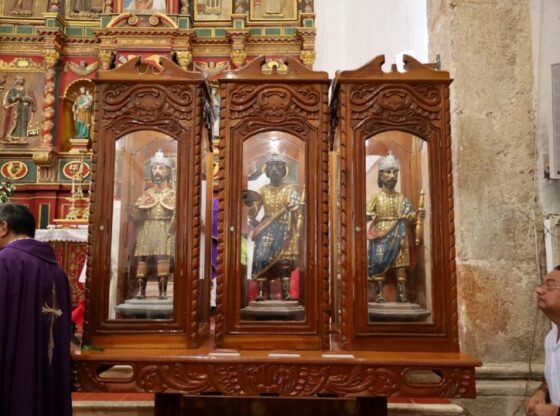

TIZIMÍN.— In a climate of symbolism and historical continuity, the Catholic parishioners of Tizimín are experiencing days of special significance after the official declaration of the Parish of the Three Kings as Diocesan Sanctuarydistinction that recognizes more than four centuries of devotion and tradition.
Added to this fact is the recent donation of new scepters that now once again carry the images of the Holy Kingsa gesture that restores an attribute that, according to records, they had not had for approximately a century.
In this regard, the Tizimileño writer Erik Ojeda Novellopresident of the Tizimín Sports Association (ADY) and researcher of local history, shared part of the investigations he has carried out regarding the origin and presence of the Three Holy Kings in this city.
Ojeda Novelo explains that there are two traditional stories, a mixture of fantasy and reality, that seek to explain how the venerated images arrived in Tizimín.
How did the Three Kings arrive in Tizimín?
The first, and the best known among the population, talks about a shipwreck in front of the port of El Cuyo. According to this version, the images would have reached the coast among the remains of a boat.
“When they carried them, they became lighter when heading towards Tizimín and heavier when they moved away, as if indicating their desire to stay here,” he says.
“The second story indicates that the images were found in a cave, and again the weight played a symbolic role: they became light when taking the road to Tizimín and heavy when choosing another direction, a sign that at that time the people interpreted as a divine sign that their place was in this city.
“We do not know with certainty which version is the true one, but both stories coincide on one point: the willingness of the Kings to stay in Tizimín,” he says.

On the other hand, he states that the exact origin of the sculptures continues to be a subject of study, since some investigations maintain that they are of European make, while others propose an American origin, specifically Guatemalan.
Likewise, he adds that recently INAH specialists were collaborating with the parish to analyze a splinter of the images and determine the type of wood.
“If it is cedar or sapote, we could confirm an American origin; if it were ebony or another different wood, it could be linked to European workshops.”
However, he comments that this study remains pending, although it could shed definitive light on its origin.
The documents reviewed by Ojeda Novelo indicate that The cult of the Holy Kings was already established around 1580.
“In 1588, a royal visitor of the Franciscan order officially recorded that the convent was completed and consecrated to the Holy Kingswhich allows us to calculate that the images could be between 437 and 440 years old, perhaps more. It is evident that, for the cult to be formally established from the end of the 16th century, the images must have already been present in Tizimín.
Regarding the scepters, he points out that the restitution was a project worked on for several years with the custodians of the images, since due to the age of the sculptures it was determined that the new scepters should be light.
As detailed, they are made of cedar wood, with hard sapote parts, and covered in gold to preserve their dignity without compromising the integrity of the figures. It specifies that the scepters consist of two pieces and have a screw mechanism for placement. Its design was based on old engravings between 1890 and 1910. that show what they were originally like.
There are paintings and images that indicate that at that time the sculptures carried bouquets or ribbons that were changed periodically, he adds.
According to calculations based on graphic records, the images had not carried scepters for nearly 100 years; They probably stopped using them even before, but there are no photographs or documents that confirm this, concludes the Tizimileño writer.
The relics attributed to the Three Wise Men They continue to inspire universal faith.
Where are the relics of the Three Wise Men?
The relics are kept in the Cologne Cathedral (Germany)inside a container known as Reliquary of the Three Kings.
According to tradition, The relics were found in the Holy Land by Saint Helena, mother of Emperor Constantine.who first took them to Constantinople, then to Milan (Italy) and finally, in 1164were transferred by order of the emperor to Holy Roman Empire —today in Cologne—as war booty.
That the remains correspond to three different ages—young, adult and elderly— coincide con medieval representations of the Magiwhich has been pointed out as one of the arguments that give credibility to the tradition.