


Please note that we are not authorised to provide any investment advice. The content on this page is for information purposes only.
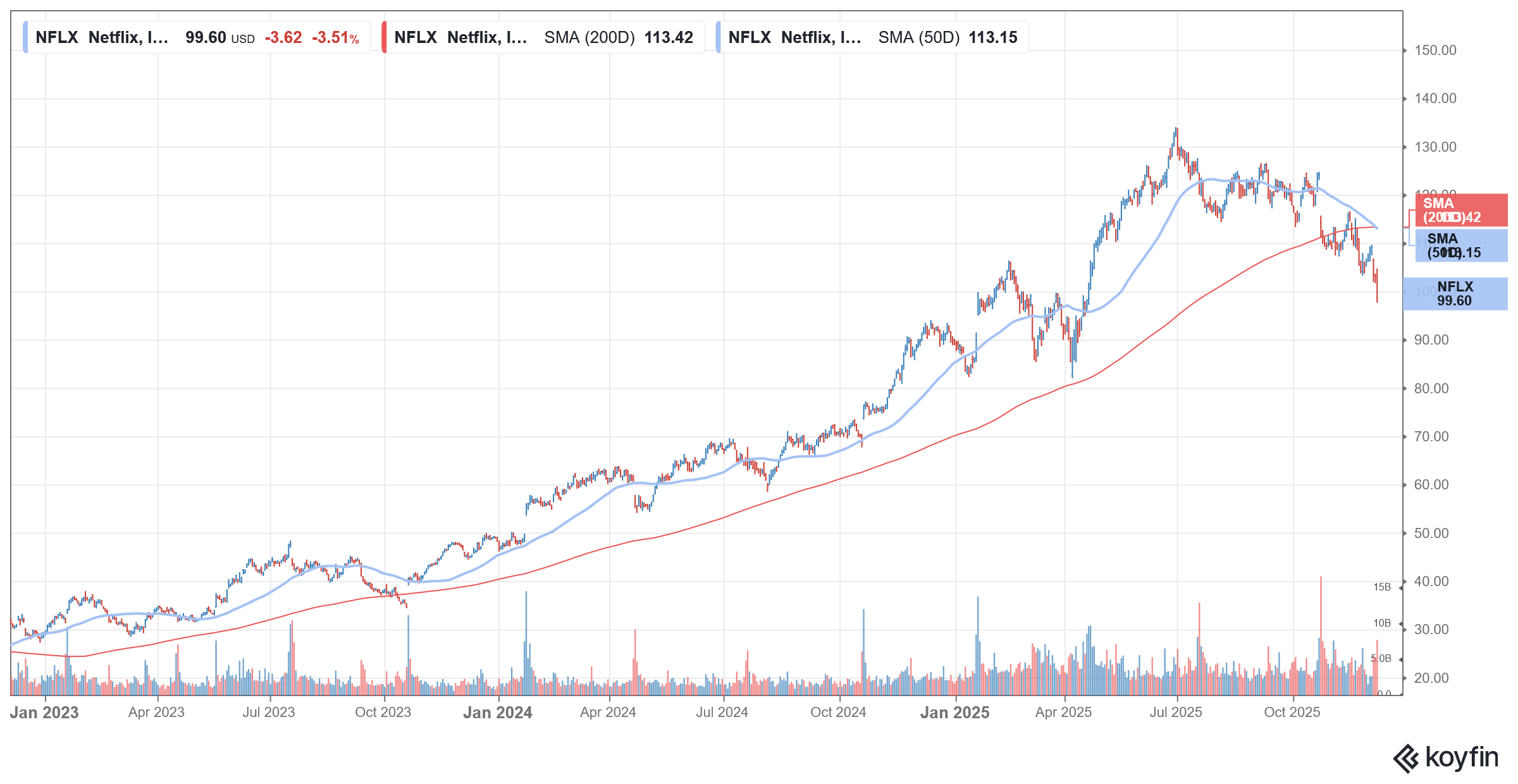
The streaming landscape is set for a monumental shift as Netflix has announced a definitive agreement to acquire the film and television studios, as well as the streaming division, of Warner Bros. Discovery (WBD) in an $82.7 billion cash-and-stock deal. This transaction marks Netflix’s largest acquisition to date and represents a significant shift for the company, which has historically prioritized organic growth. Netflix stock has whipsawed today after announcing the deal, which is expected to face regulatory scrutiny.
Netflix to Acquire WBD Properties
NFLX will take control of WBD’s most prized properties, including the legendary Warner Bros. film and TV studios, the premium streaming service HBO Max (and HBO), and a vast content library that includes major franchises and classic titles.
Before the deal’s final closure, Warner Bros. Discovery plans to spin off its linear cable TV channels, such as CNN, TBS, and TNT, into a separate, publicly traded entity named Discovery Global.
The total enterprise value of the acquisition is approximately $82.7 billion (including debt), valuing WBD’s studio and streaming assets at $27.75 per share, of which $23.25 would be paid in cash and the remaining $4.50 in the form of Netflix shares.
Netflix Says Deal Will Add Shareholder Value
“This acquisition will improve our offering and accelerate our business for decades to come,” said Greg Peters, co-CEO of Netflix. He added, “Warner Bros. has helped define entertainment for more than a century and continues to do so with phenomenal creative executives and production capabilities. With our global reach and proven business model, we can introduce a broader audience to the worlds they create—giving our members more options, attracting more fans to our best-in-class streaming service, strengthening the entire entertainment industry, and creating more value for shareholders.”
Netflix Co-CEO Ted Sarandos stated that the combination will help “define the next century of storytelling,” merging Netflix’s global platform with Warner Bros.’ century-long legacy of content creation. The deal is expected to result in $2 billion to $3 billion in annual savings by the third year.
Why is Netflix Acquiring WBD?
The most immediate and compelling reason is the acquisition of one of Hollywood’s most prestigious and deep content libraries, effectively creating a “content superconductor.” Netflix gains outright control of beloved, multi-generational intellectual property (IP) that drives cultural relevance and merchandising, including Batman, Superman, Harry Potter, Wonder Woman, The Sopranos, Game of Thrones, Succession, and The White Lotus.
By owning this content, Netflix eliminates billions in future licensing costs and the risk of titles being pulled by rivals. The sheer volume of new content reduces “hit-rate risk” and strengthens the value proposition for its subscribers globally. As Netflix Co-CEO Ted Sarandos noted, the mission to “entertain the world” is better achieved by combining their “culture-defining titles” with Warner Bros.’ century-long legacy.
The merger combines the world’s largest streaming service by subscribers with HBO Max, a premium, critically acclaimed competitor. Analysts predict the combined entity will command over 21% of US streaming viewership, creating a significant market gap between Netflix and its remaining competitors, like Disney+ and Amazon.
Netflix expects to realize at least $2-3 billion in annual cost savings by the third year. This will come from eliminating duplicated services (like merging HBO Max into the Netflix platform), integrating production infrastructure, and optimizing back-office functions. This massive saving provides a financial cushion to reinvest in original content or pass savings on to consumers through bundled offerings.
Netflix will gain one of Hollywood’s most powerful, century-old production and global theatrical distribution studios. This vertical integration provides greater control over the entire production cycle, from greenlight to global release, enhancing studio capabilities and production capacity.
NFLX’s Library Would Expand
The vast, high-quality content influx is designed to attract and retain more subscribers, drive more engagement, and generate incremental revenue, thereby accelerating business growth for decades. The deeper library also makes the service more appealing to a broader, global audience.
The deal prevents a rival (such as Comcast or Paramount, who were also bidding) from acquiring the assets and instantly creating a more formidable competitor. In an industry where franchise IP is now everything, this move locks up invaluable assets, raising the barrier to entry for other media players
The deal follows a fierce bidding war that saw competition from rivals like Paramount Skydance, and Comcast. The path to completion, however, is expected to face significant obstacles, primarily concerning antitrust scrutiny.
The massive consolidation has already drawn fire from industry figures and regulators concerned that it would give Netflix “too much power over Hollywood,” potentially stifling competition and reducing licensing opportunities for smaller players. Netflix has included a large $5.8 billion breakup fee if the deal fails due to regulatory challenges, signaling the expectation of a tough review process.
NFLX-WBD Deal Might Face Regulatory Scrutiny
Paramount Skydance, an unsuccessful bidder, has already raised concerns about the fairness of WBD’s auction process, alleging it favored Netflix. According to reports, the Trump administration views the deal between WBD and Netflix with “heavy skepticism.”
The comment, made to several media outlets following the deal’s announcement, suggests the proposed merger, which would combine the world’s largest streaming service with one of Hollywood’s most prestigious studios and the third-largest streamer, is heading for a potentially lengthy and aggressive antitrust review by the Department of Justice (DOJ).
One government official, who attended a high-level meeting on the merger, was quoted as saying, “Basically, everyone agreed that Netflix presents unique antitrust concerns and if it won the bidding war it would be one long slog and touch off an investigation along the lines of those of Google and Amazon.” This suggests the DOJ’s antitrust division may use the merger as an opportunity to scrutinize Netflix’s entire business model, a level of examination the company has thus far avoided.