


MÉRIDA, Yucatán.— Centuries before the appearances of the Virgin Mary to Juan Diego in it Tepeyac hill, in Mexicothere was already one great devotion to the Virgin of Guadalupe in Extremadura, Spain.
In December 2016, Monica Cruz published in the verne websitefrom the Spanish newspaper The Countryan interview with Alicia Mayerhistorian of the Autonomous University of Mexico (UNAM).
Origin and meaning of the name Guadalupe
The historian explains that the name of Guadalupe It has at least three versions. One of them points out that comes from the Arabic “Wuad-al-luben”which means hidden river; another suggests that it is a combination between Arabic and Latin, Wuad (river) and lupuswhich in Latin means wolf.
A third version says that Its root is Nahuatlwhich was the language with which the indigenous Juan Diego communicated with the Virgin Mary in her appearances on the Tepeyac hill, in 1531; in this case, The term would be “coatlaxopeuh“which means the one who crushes the snake, according to the historian.
The Guadalupe River
There are other versions, such as the one proposed by geographical, statistical and historical dictionary of Spainof Pascual Madoz of 1847, which offers details about the Guadalupe Riverand explains that the Guadalupe River passes near Alía and Valdecaballeros and flows into the Guadiana River, in the southwest of the Iberian Peninsula.
And he adds, this river was formerly called Lupus, whose name with the Moorish word guada, which means river, makes up the name Guadalupe, which in turn gave rise to the name of the image of the Virgin Mary that was found in its vicinity and the sanctuary that was later built.
The banner of Hernán Cortés

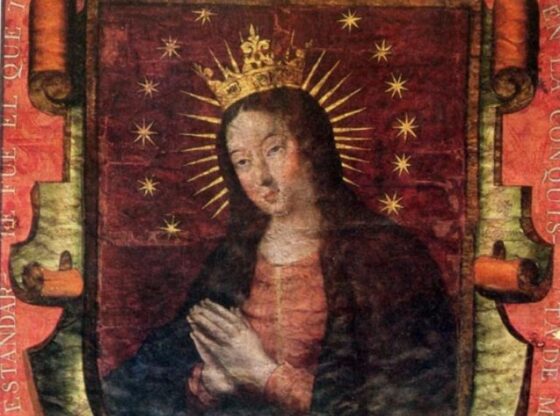
During the conquest of Mexico, Hernan Cortes carried a banner that is currently in the National Museum of Historyin the Mexico City.
The banner measures about three meters high by two and a half meters wide, embroidered on silk fabric, made in the Royal Monastery of Santa María de Guadalupe.
On the obverse, a copy of the image of the Virgin of the Monastery of Guadalupe is embroidered, and on the reverse the shields of Castilla y León.
The Spanish historian and journalist James Earseauthor of the novel “The Secret of the Virgin of Guadalupe”obtained permission from Chapultepec Museum to publish in his book the image of both parts of the Banner of Hernán Cortés.
According to Santiago Mata, doctor in History, the similarity between the image embroidered on the banner and the one that appeared printed on the tilma of Juan Diego Cuauhtlatoatzin caused the name of Our Lady of Guadalupe to which was left engraved on the yacht.
The Monastery of Santa María de Guadalupe
The Virgen de Guadalupe de Extramadura It is a Marian dedication whose sanctuary is located in the Royal Monastery of Santa María de Guadalupein the town of Guadalupe, in Cáceres, Spain.
The celebration of the Virgin of Guadalupe as the patron saint of Extremadura takes place on September 8, as well as on October 12, as the patron saint of Hispanidad.
The monastery and the basilica of Guadalupe were declared World Heritage Site in 1993 by UNESCO.
Legend about the origin of the image

A legend tells that the image of the Virgin of Guadalupemade in cedar woodof Romanesque style, which measures 59 centimeters in height, was made in a workshop in Palestine in the first century by San Lucas Evangelista. Centuries later it was venerated in temples of Achaia and Byzantium.
The Pope Gregory the Great he gave the sculpture to Saint Leanderarchbishop of Visigothic Seville, who placed it in a hermitage on the outskirts of the town. During the muslim invasion of 711, the image was deposited in a box and buried next to the built.
The legend tells that in the 12th century, the Virgin Mary appeared to a cowboy from Cáceres called Gil Cordero and told her that there was an image of her buried next to the Guadalupe River.
On one occasion when Gil Cordero was near the river, one of his cows got lost and when he found it it was dead. Before skinning it to use its skin, he made a sign in the shape of a cross on the animal’s belly and was resurrected.
This situation made Cordero think that perhaps this was the place that the apparition had pointed out to him, so he began to dig and found the box with the image inside. Then, he gathered stones and built a cabin where he deposited the virgin.
Afterwards, he went to the church of Cáceres and narrated his discovery and said that the Virgin wanted to receive worship in that place, however, the clergyman did not believe him, so Gil Cordero went home and, when he arrived, he found his son lifeless and prayed to the Virgin to bring him back to life.
When the clerics were preparing to officiate the funeral, Gil Cordero’s son came to life, stood up and said that a woman had helped him up. In this way, the clerics believed and agreed to build a hermitage for the Virgin.
History of the Virgin of Guadalupe of Extremadura
The The first historical reference to this Virgin is from 1326.. It is an episcopal document in which plenary indulgence is offered to anyone who visits the church of Santa María de Guadalupe.
In a letter from King Alfonso XIfrom the year 1335, said that the church was in ruins and between 1335 and 1338 he built a new church. In 1340 Alfonso XI renovated the church and built other attached buildings.
Queen Elizabeth’s Paradise
The German humanist, physician, geographer and cartographer, Hieronymus Münzerco-authored by “The Nuremberg Chronicles”considered that the Monastery of Guadalupe It was “paradise” for Queen Isabel la Católicawho visited him about twenty times.
According to Münzer, Queen Isabel had a great devotion to the Virgin of Guadalupe.
Isabella first visited the monastery in 1464, ten years before she was crowned queen of Castile in 1474.
The Monastery of Guadalupe and the voyage of Christopher Columbus
After the reconquest of Granada in January 1492, the monastery was the meeting place between Christopher Columbus and the Catholic Kings.
In the chapter house of the Monastery, on June 20, 1492, Isabel and Fernando dictated two letters addressed to Juan de Peñalosa, their administrator in the city of Palos, whom they requested deliver two caravels to Columbus to begin his journey to the Indies.
Patroness of Extremadura and Hispanidad
The Virgin of Guadalupe has been the Patroness of Extremadura since October 12, 1906, whose liturgical holiday is September 8.
On October 12, 1928, the Virgin of Guadalupe was canonically crowned as Queen of Hispanidad by the Cardinal Primate of Spain, Pedro Segura, special legate of SS Pius XI, in the presence of King Alfonso XIII.
“Saint Mary of Guadalupe, full of grace, Mother of God, Queen of Spain, pray for us sinners”Latin inscription engraved on the crown of Santa María de Guadalupe.
The origin of Guadalupe devotion

On November 4, 1982, Pope John Paul II visited the sanctuary and celebrated a mass, during his homily, Pope John Paul II acknowledged: “The great esteem I have for the Virgin of Guadalupe of Mexico is indisputable. But I realize that her origins are here. Before having gone to the Basilica of Tepeyac, I should have come here to better understand Mexican devotion.”