


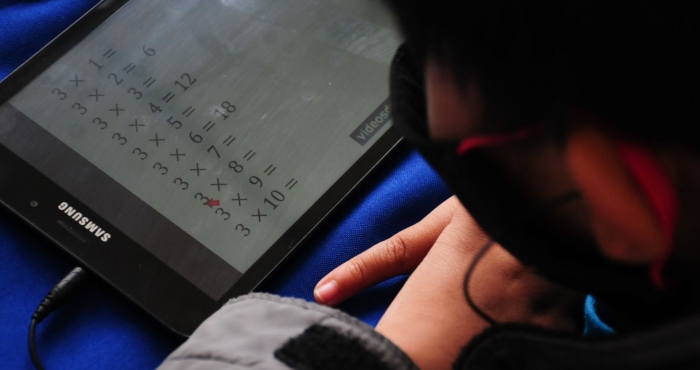
The semester at the university where I work has just finished. The element in common with my groups was the use of screens. They are no longer phones, because they can be required not to be taken out during classes. The problem is tablets and computers.
Every day it is more common for students to no longer carry notebooks. The traditional custom of making notes by hand, on paper, based on what the teacher dictates, copying from the blackboard or solving, has been lost. And this will only increase. Nowadays, many of my students take notes on tablets or computers. More in the first than in the second, which also implies a certain transition.
It turns out that the most advanced tablets have a digital pen, making it easy to do what could not be done before on a computer: solve mathematical exercises. On the device you can make the necessary calculations, the progressions, and have very large sheets where the most complex operations can fit. It is enough to cross out a mistake in an equation for it to disappear. Not to mention the capacities for gratification.
Although I am convinced that writing by hand has countless advantages, the truth is that I could be wrong, speaking from the nostalgia of someone who has not adapted to current technology. So it is almost impossible to prohibit those notes that, in some cases, can even be converted into text with some traditional typography, from being taken on tablets.
A calculus teacher tells me that sometimes students solve functions or matrix multiplications on their screens faster than he can. And how not? If there are already programs that verify what you do. Furthermore, when they do not understand something, when they get stuck on an exercise, students ask the AI not only to solve the exercise, but to do it step by step. Without a doubt, it is a technology that will have to be taken advantage of.
The cons are obvious: we increasingly have students who are more distracted, with less ability to concentrate. And the thing is, between one step and the next, between a diagram that is made on the board and some points that are important to highlight, they take the opportunity to play in an app, to check their emails, to respond on Instagram or to watch a short video. It is not uncommon for one of the screens to suddenly play audio from a video. They are no longer even ashamed when that happens, they ask for forgiveness and the next thing.
As said, this phenomenon will only increase and, regardless of one’s preferences regarding literacy, the truth is that we must soon find strategies that incorporate these technological capabilities. Although, it occurs to me that in a not too distant semester, teaching in-person classes will be too similar to teaching them remotely.
If as a university professor I worry, as a father of two teenagers much more. I hope my fears are unfounded.