

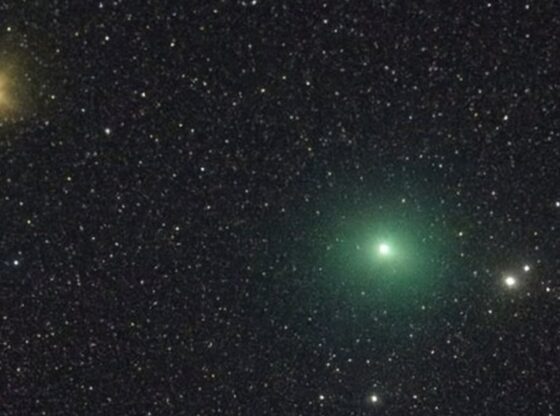

Seven billion years old and traveling at 250,000 km/h, this ancient interstellar visitor will pass by us in December before disappearing forever into space.
Berlin, December 2 (DW).- He was probably already flying through the space when our solar system did not exist yet: 3I/ATLAS is an unusual guest who will be especially close to the Tierra in December.
It was only discovered in summer, and soon it will get as close as possible to us: 3I/ATLAS las is not a normal comet. This visitor from a distant solar system is incredibly ancient and travels at breakneck speed. What’s behind this cosmic corridor and how you can see it.
Why is 3I/ATLAS special?
From time to time comets that come from our solar system pass near Earth. 3I/ATLAS, on the other hand, is an interstellar object, and only the third confirmed after 1I/’Oumuamua and 2I/Borisov. Interstellar comets are celestial bodies from other star systems that pass through ours at high speed.
Every planet, every moon, every asteroid, every comet and every life form in our solar system has a common origin, only interstellar comets are outsiders. 3I/ATLAS was discovered in early July with the “ATLAS” telescope in Río Hurtado, Chile. The cigar-shaped 1I/’Oumuamua, about 400 meters long, had passed close to the Sun in 2017, followed in 2019 by 2I/Borisov.
🚀 3I/ATLAS — Interstellar Visitor Shows Powerful Coma Structure
3I/ATLAS Images: https://t.co/00hpNCh9Zx
Captured by Chuck’s Astrophotography • Processed & refined by (Ammar A.) • Dec 2, 2025Today’s observation of 3I/ATLAS (C/2025 N1) reveals one of… pic.twitter.com/LlNXkfRGt9
— SpaceTracker.space (@Ammar1176708) December 3, 2025
Where does 3I/ATLAS come from?
Researchers have not yet been able to determine the exact origin of the comet. It has probably been moving through the galaxy for several billion years and comes from the so-called thick disk, a structural element of the Milky Way made up of older stars, according to the European Space Agency (ESA).
What happens now?
3I/ATLAS passes through our solar system at a breakneck speed of up to approximately 250 thousand kilometers per hour (km/h), the highest speed so far recorded for a visitor to the solar system.
For comparison: the Earth moves in its orbit around the Sun at an average speed of just over 100 thousand kilometers per hour. The comet shrouded in gas and dust will come closest to our planet on December 19. Shortly after, according to ESA, it will disappear into the depths of space and never return.
Can I see the comet?
The naked eye or binoculars are not enough. Amateur astronomers were able to view 3I/ATLAS recently with a medium telescope in the deep eastern morning sky. But according to ESA, 3I/ATLAS is expected to lose some of its shine. Then a larger telescope might be necessary.
The night skies have some special gifts for you this December:
– The peak of the Geminid meteor shower
– The closest approach of 3I/ATLAS to Earth (at about 170 million miles)
– A Jupiter-Moon conjunctionGet more details on this month’s celestial sights: pic.twitter.com/hpm5fyOmTc
— NASA (@NASA) December 1, 2025
The best opportunities are in remote locations with little light pollution. The good news: “In these weeks, the comet will reach a higher position before dawn, which makes observation more comfortable.” Observatories and astronomical institutions offer various observing opportunities.
Will it be dangerous in December?
No. When the comet comes closest on December 19, it will be on the other side of the Sun, at a distance of 270 million kilometers. For comparison: the average distance from the Earth to the Sun is approximately 150 million kilometers. The ESA assures: also for other planets in our solar system, this well-traveled visitor is harmless.
What’s so fascinating about 3I/ATLAS?
“Interstellar comets are true outsiders, carrying clues to the formation of worlds far beyond our own,” says ESA. Astrophysicist Chris Lintott explains: “This is an object from a part of the galaxy that we have never seen up close.”
Furthermore, 3I/ATLAS appears to differ significantly from its two predecessors. According to the NOIRLab astronomical research center in Tucson (USA), with an estimated diameter of 20 kilometers it is considerably larger than previously observed visitors from the depths of space. It also moves in a significantly more elongated orbit.
URGENT The ALMA Observatory detected methanol (CH₃OH) and hydrogen cyanide (HCN) on the interstellar comet 3I/ATLAS, at unusually high levels. Both compounds are relevant to prebiotic chemistry.
The object will reach its closest approach to Earth on… pic.twitter.com/2LGArLGyzO— World Alert (@TuiteroSismico) December 3, 2025
3I/ATLAS could be the oldest comet ever observed: researchers from the British University of Oxford estimate that it is possibly more than seven billion years old, and therefore more than three billion years older than our solar system.
How rare are interstellar comets?
So far it is unclear whether such visitors are rare or difficult to detect. “There is a suspicion,” said astronomer Rainer Kresken of ESA’s Planetary Defense Office in Darmstadt. “That is to say, quite a few of these objects have already been observed. But under the assumption that they are in orbit around the Sun, they have not been adequately investigated further.”
Interstellar guests could have been there frequently and also been seen, but not recognized as exotic visitors.