

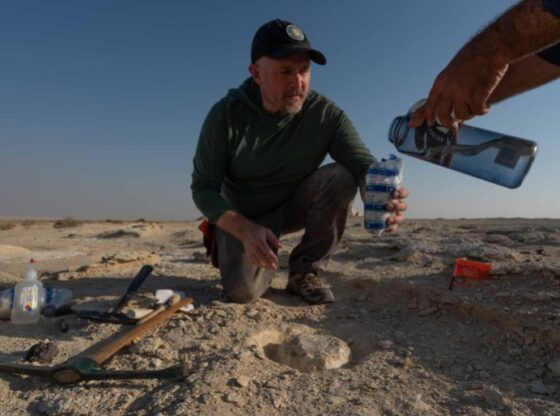

The discovery of a unique assemblage of dugongs at the Al-Mashabiya fossil site in southwestern Qatar was not only a local scientific achievement, but also a very important discovery at the international level. In addition to being the oldest and richest known fossil assemblage of these marine mammal creatures that lived over millions of years feeding on seaweed and playing a pivotal environmental role, the site also witnessed the documentation of a new species of them for the first time, giving the discovery, which was announced a few days ago in a study published in the journal “Per J,” scientific value.
The importance of the deeper discovery lies in the implications it carries, mentioned in the study, that the discovery site is not just a fossil collection, but rather a preserved record of an integrated marine ecosystem dating back approximately 21 million years.
Based on this scientific momentum, and the wide interest in research circles sparked by this discovery, which was made in cooperation between Qatar Museums and the National Museum of Natural History, affiliated with the Smithsonian Institution, Al Jazeera Net conducted a dialogue with Dr. Nicholas Benson, curator of the Department of Marine Mammal Fossils at the Smithsonian Institution Museum and the main researcher of the study, to find out the backgrounds of the discovery and its scientific dimensions, and what the fossils of the past tell us about the future of the Arabian Gulf and its marine environment.
Different attributes
-
First, what is the main evidence that you relied on to conclude that the Al Mashabiya fossil site in southwestern Qatar is not just a fossil assemblage, but rather a preserved record of an integrated marine ecosystem dating back to ancient times?
Our evidence is that we have not only found ancient dugongs, although they make up the vast majority of fossils discovered, but we have also found evidence of extinct dolphins, ancient relatives of barracudas, and sea turtles. Although none of these organisms are species living today, 21 million years ago they were performing ecological roles similar to those we currently see within seagrass communities.
-
Does the high density of dugong bones at the site indicate a single mass die-off, or a long-term accumulation spanning millions of years? How do you scientifically distinguish between these two scenarios?
Many of the characteristics of the high density of dugong bones in the Masahaba layer do not support the hypothesis of a single mass die-off. For example, the bones come from different layers within a rock unit about 50 centimeters thick, which likely represents a time period extending about 10 thousand years, about 21 million years ago. This period may seem long from our human perspective, but it is relatively short according to geological standards.
In addition, we did not find complete, connected skeletons, and about 95% of the bones show minor degrees of wear, some of which are covered in oyster deposits. Together, these features indicate that the bones gradually accumulated over time, which supports the interpretation of the site as a long-term settlement area, or a “magnet” for ancient dugongs. This type of settlement has modern counterparts off the coasts of Qatar, Bahrain, and Saudi Arabia, where herds of dugongs live today in the Arabian Gulf.
-
One of the most prominent aspects of your study was the announcement of the discovery of a new species of dugong, which was named “Salwaserin tarensis.” You said that it was a miniature copy of the current dugong. What were the main anatomical features that led you to classify the discovered specimen as a new species and not just a dwarf form of a previously known type of dugong?
The reference skeleton, or what is known as the “typical specimen” for this new species, belongs to an adult individual, and this is evident from the fusion of the skull bones, which confirms that it is not young. We also observed unique features in the skull, especially in the roof of the skull, the sides of the skull, and the area surrounding the eye socket. These characteristics enabled us to diagnose this new species and prove its difference from all previously described species of sea cows, whether fossil or modern.
In addition, this new species was easy to distinguish from the current dugong by the presence of small hind limbs resembling hands, which we reconstructed to look like small flippers. Today’s dugongs have completely lost these bones, as happened to whales, as a result of an adaptive process that lasted millions of years.

Ecosystem engineer
-
You mentioned in your study that ancient dugongs played a role similar to the role that dugongs play today in the Arabian Gulf, as each of them can be described as “ecosystem engineers.” How did you reach this conclusion?
The density of fossils at the Al-Mashabiya site shows a remarkable similarity to the density of dugong strandings recorded today in northwestern Qatar. Based on the shape of the tusks and snouts, we see that “Sluacerin tarensis” played a similar ecological role as an engineer of seagrass systems during the early Miocene. While feeding on them, it digs paths in the sandy or clay bottom. These movements release nutrients buried in the sediments, such as phosphorus and nitrogen, and they become available to plants. and other animals. These activities contribute to revitalizing marine soil, increasing the diversity of living organisms, and maintaining the health of the ecosystem.
In addition, Sloaserine tarensis had a gently curved snout with small tusks, whereas today’s dugong has a highly curved, boomerang-shaped snout with thin, finger-sized tusks.
In some other fossil dugong species, including species found in contemporary rock layers in India, the tusks were much larger and sharp, resembling a chisel blade. It is not surprising that dugongs had tusks, given their close relationship to elephants, but they abandoned terrestrial life and moved to the sea about 50 million years ago.

An important question with no definitive answer
-
What does the fossil record reveal about the ability of dugongs and kelp communities to adapt to climate change and salinity fluctuations over geological time?
This is an important question, but it is difficult to provide a definitive answer due to the lack of accurate data on water temperature and salinity during the early Miocene. However, the basic conclusion we have reached is that this region of the world has remained an ideal habitat for dugongs over the past 21 million years, with the species that have filled this role varying over time.
The fossils also show that “Sloacerin tarensis” shared its habitat with other vertebrate marine organisms from the early Miocene era, including sharks, barracuda-like fish, extinct dolphins, and perhaps sea turtles as well, and we are still working to accurately determine their identity, with the hope of describing them scientifically in later studies.
What is interesting is that all of these fossil species are extinct today, and have been replaced in the Arabian Gulf by other, unrelated species. In other words, the region has witnessed a complete change in players, but the environmental roles have remained constant.
-
Speaking of environmental dimensions, do fossils indicate the existence of environmental thresholds that can be used as an early warning system for the challenges facing today’s seagrass systems in the Arabian Gulf?
I do not believe that staghorn fossils provide direct early warning indicators of environmental thresholds or challenges to modern seagrass systems. These thresholds require precise measurements, while our data from the geological past are less precise in detail.
But on the other hand, our results highlight the historical antiquity of this environmental type in the Arabian Gulf, as the Al-Mashabiya site bone collection may have occurred during a peak in marine biodiversity in the early Miocene era, and it was centered over the Arabian Shield, after the center of marine biodiversity gradually moved from Europe tens of millions of years ago to its current location in the India/Australia archipelago.
In other words, these fossils open a window into a period when the Arabian Peninsula was a global center for marine biodiversity.

Beginning of further studies
-
What are the next research steps after this study? Does it include expanding fossils or doing advanced analyzes such as studying stable isotopes to reconstruct ancient diet and environmental conditions?
We will follow up this study with a second paper examining Sluacerine tarensis in more detail, as we have more fossils that show additional anatomical details that scientific disciplines will appreciate and find useful. As I mentioned previously, there are other types of these rock units, including extinct turtles and even ancient crocodilians, and my colleagues and I plan to describe them in future studies.
Ultimately, we want to compare the results on a larger scale in the Gulf, because the rocks that contain the assemblage of scavenging bones are widely distributed across the Gulf from Saudi Arabia to Oman, and these rocks reflect a similar coastal environment from the same era, which means that they were part of the same coast. We would not be surprised to find more species of dugongs and perhaps even “Sloaserine tarensis” in other areas of the region, because sea cow fossils are often found in groups containing several species, and we believe that more fossils in the site’s bone assemblage Marsupials may reveal additional species of dugongs.
-
Are there plans to develop the Al-Mashabiya site as a long-term research project aimed at reconstructing the environmental history of the Arabian Gulf over millions of years?
My colleagues from the Qatar Museum stressed that the most important part of our cooperation is ensuring high-level research while providing the best possible protection and management of these sites, so that we can preserve them for future generations. We have already achieved this step at the national level by protecting Al-Musahabiya, and now they plan to take it a step further by seeking to nominate it in the future to become a UNESCO World Heritage Site for wider recognition.
For me the exciting part is that with protection we can ensure that we can one day answer questions about long-term changes in the environmental history of the Arabian Gulf. We have only just taken the first steps in understanding the Gulf’s fossil record, and we know that future researchers can answer questions we have not yet thought about, if they have such fossils and sites to study.
-
Finally, after working on marine mammal fossils around the world, what makes this discovery in Qatar special for you, scientifically and personally?
It is an honor and privilege to work as a scientist in Qatar alongside colleagues whose responsibilities focus on preserving and sharing heritage. For me, international collaborations are most satisfying when research supports the conservation of natural heritage while also building scientific capacity, especially through museum collections, both real objects and digital copies. The Smithsonian has a dual mission of producing and sharing knowledge, and I am very excited to do this work in partnership with my colleagues.