


A virtual assistant that can be called by any woman in a situation of dangerin order to assess risks, facilitate the sending of emergency alerts, in addition to providing initial emotional support and indicating support resources. These are some of the functions of ‘Eleonor’, the Artificial Intelligence tool that will work in the ‘Mais Mulher’ mobile application.
The project is led by Brazilian researcher, journalist and writer Iara Lemos, will be focused on Portugal, initially, with launch scheduled for November 2026 and expansion to other European countries and Brazil. Iara is a master’s student in Women’s Studies – Gender, Citizenship and Development at the Open University of Lisbon, in addition to being appointed by the United States Department of State to the Artificial Intelligence collegiate of the Organization for Economic Cooperation and Development (OECD).
In addition to her personal proximity to Portugal, Iara Lemos cites deficiencies in combating violence against women as the reason for choosing the country to start the project, which is in the testing and fundraising phase, with a work team of 14 people in Portugal and Brazil.
“Portugal does not have a classification of femicide. We have made significant progress in recent times in protecting women, but the legislation and support provided are still very weak. There are few places to turn in cases of violence. Police stations are not prepared to receive women. An attempted femicide leads to domestic violence, which can have a broader aspect”, he explains.
Support at the Vatican
A app ‘Mais Mulher’ and the functions of ‘Eleonor’ were presented at the Holy See. “The Vatican was chosen above all because of the weight of the Catholic Church in Portugal, this summit that talks to the Portuguese population face to face and has the power to make a difference in this scenario”explains Iara Lemos to DN.
The researcher had a meeting with the secretary of the Dicastery for Culture and Education, Bishop Paul Tighe, Cardinal Tolentino Mendonça’s ‘number two’ in this department. “He [Tolentino Mendonça] he was unable to meet me personally, as the Pope was going to travel to Turkey, but he sent me, and even wrote that it was a request in his name, to this meeting”, says Iara Lemos. “The support of the Church is fundamental. I left very happy, Monsignor Tighe is considered the technology brain at the Vatican”, he adds.
It was also at the Vatican that the Portuguese government became aware of the initiativeduring a meeting between the researcher and Lúcia Portugal Núncio, minister counselor of the Portuguese embassy in the Holy See. “The embassy was willing to participate in conversations about the project, because we will obviously need support from the Government and the authorities.”
‘More Woman’
According to Iara, the mobile application will be more than a security tool. “The woman enters the app and has an immediate welcoming space for the different forms of vulnerability that she is going through at that moment. Whether it’s the need to call a police agency or seek psychological or health care. Vulnerability encompasses different sectors that affect women’s lives. If one doesn’t go well, the others tend to become unbalanced.”
Upon entering the app‘Eleonor’ will be able to detect, based on the ‘conversation’ initiated by the user, the levels of risk to which she is subject, distinguishing whether there are, for example, external threats, or even suicidal ideas, to activate the most appropriate security protocols.
Iara Lemos explains that the application will use intelligent geolocation to identify and suggest the closest responses to the victim, such as women’s support centers and police stations, considering, with the analysis carried out by AI, the feasibility of traveling to the locations. Furthermore, the app there will be an easier system for sending alerts, a type of “emergency button”, with the help of an image that creates a ghost screen, so that the attacker, if he is close to the cell phone, will not be able to see what the victim is doing. The answers may also be directing the user to professional legal or therapeutic help.
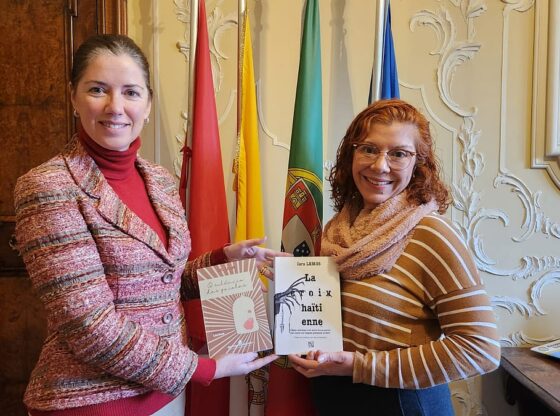
Iara Lemos is the author of the book-report “The Haitian Cross”, which shows how the Catholic Church hid, in Haiti, religious people accused of sexual abuse against children, and even investigates the former Portuguese priest Frederico Cunha, sentenced to prison for the murder of a 15-year-old boy, in Madeira, in 1992, and who will be living in Brazil.
Her most recent work is the book ‘O Silêncio das Gaiolas’, which brings accounts of women victims of violence – including her own, in the first person – and which originates from the research she is conducting, as part of her master’s degree, on human trafficking of women. During the investigation, he discovered criminal networks operating in Portugal and Spain, with greater activity in Greater Lisbon and also in the Braga region, close to the border..
“When we manage to turn the key and bring technology to protect women today, other generations will benefit. We are planting seeds. We, who are women who see and experience violence, if we can leave the seed so that it grows in a healthy way, we will have a better future. When we talk about feminism and policies for women, the road is long and arduous”, says the writer.