

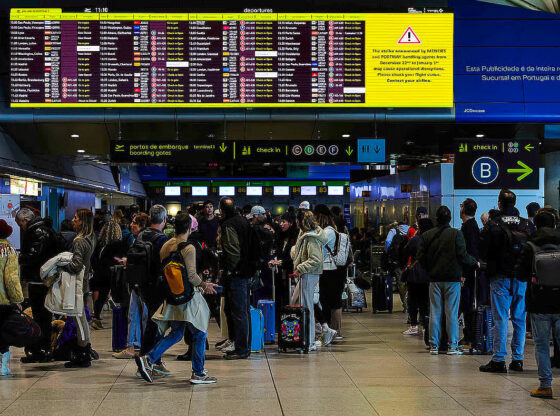

The Portuguese Hotel Association (AHP) warned the Government of the possible “collapse” of Lisbon airport, due to the impact of the new European Entry and Exit Control System (EES) coming into operation.
In a letter to the Prime Minister and the Ministers of Economy and Territorial Cohesion, Infrastructure and Housing and Internal Administration, entitled “Portugal cannot be hostage to its border”, the AHP management expresses “its deep concern about the situation at Humberto Delgado Airport, in Lisbon (and, to a lesser extent, also in Faro) since the entry into force of the new European Entry and Exit Control System (EES)”.
Speaking to Lusa, Bernardo Trindade president of AHP regrets the situation of the main national airport infrastructure.
“Today’s situation at Lisbon airport is far from satisfactory and where the Portuguese State, which is not the State of this Government or is not the State of the previous Government, is the State that, globally, has failed and fails daily”, in “timely border control, generating indeterminate queues, failure in security, failure in its status even as grantor under a concession contract and, above all, failure to take care of the image of Portugal”, he indicates.
“Our appeal, our open letter, which is, above all, a sincere appeal, is that, in fact, the conditions are created so that this airport infrastructure is not, in fact, a terrible gateway for those who want to visit Portugal”, highlighted the leader of the association.
In the letter, AHP said that “this system, mandatory at all external borders of the Schengen Area, introduces more time-consuming and technologically demanding procedures, including the collection and biometric registration of citizens of third countries”, he recalled, indicating that “the absence of adequate human and technical resources for its implementation in Portugal is causing unacceptable delays in arrivals and departures, with severe impacts on the operation airport, the country’s image and the confidence of travelers”.
According to AHP, Lisbon airport, “has already been operating under overload for a long time” is now in a “state of serious dysfunction”.
For the association, “the endless queues that occur today at border controls, both upon arrival and departure” constitute the “predictable and regrettable consequence of an implementation model without sufficient resources or effective coordination”.
The AHP points out “multiple” consequences, such as “the loss of air connections and direct risk to the TAP hub, whose viability depends on the fluidity of connection times” “cascading” delays in both departures and arrivals, “saturation in baggage carousels and ground operations” as well as a “worrying degradation” of the visitor experience.
The association recalls that tourism represents “around 12% of the national GDP and the Lisbon region is responsible for more than a quarter of the country’s tourist demand”, warning of the “risk” of destroying, “through administrative inefficiency, one of the country’s main sources of economic growth and international prestige”.
“And the situation is all the more serious as it is only the first phase of the EES”, he indicates, remembering that in December “a more demanding stage will begin, with mandatory biometric collection at self-service kiosks for around 35% of international passengers”.
In the letter, AHP warned that “if human and technical resources are not quickly reinforced, the system will collapse due to the predictable increase in complexity and volume”, indicating “in addition to the aforementioned impact on the country’s economy and image, this collapse will generate, among other victims, the very Portuguese citizens who necessarily use the airport, namely those of the new generation of the diaspora”.
The association proposes the immediate reinforcement of police personnel assigned to border control and adequate planning for busy periods, the immediate repair/activation of eGates and RAPID machines, and the “public definition of maximum acceptable waiting times for passengers from third countries and regular monitoring of results”.
AHP also wants the “approval of a national contingency plan for traffic peaks, with temporary reinforcements and additional posts when necessary” and “transparent communication with passengers and tour operators”, coordinated with Turismo de Portugal, as well as the “continuous assessment of the implementation of the EES”, including a “quarterly report from ANA to the Government (and publicly available) on the status of implementation, number of posts assets, number of passengers processed, average and percentile of waiting times, recorded technical failures and correction plan”.