

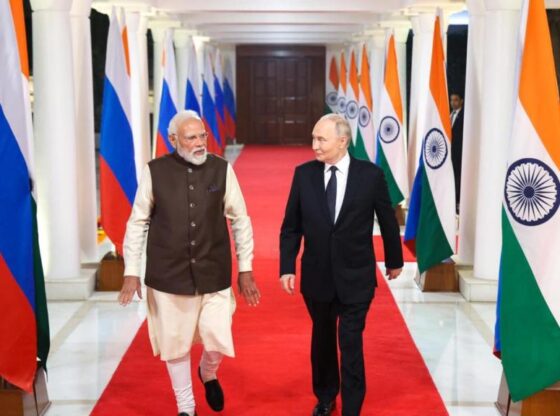

This Thursday Vladimir Putin has landed in India, thus beginning an official visit – the first in four years – that aims to strengthen ties with the Asian power at various levels; also the military. The Russian leader has been received by the Indian Prime Minister, Narendra Modiat the same New Delhi airport. An unusual gesture that shows the good relationship between both leaders.
Theoretically, Putin’s visit seeks to strengthen the economic alliance between both countries. And, after the 50% tariffs imposed by Donald TrumpModi must increase exports to alternative markets while Putin needs many of the things that India offers: from food – shrimp, rice, fruit – to heavy machinery, including, of course, car parts and electronic equipment.
It should be remembered that, initially, the tariffs imposed by Trump on India were ‘only’ 25%. But at the end of August the US president decided to double them in order to penalize the growing import of Russian oil – which went from 2.5% in 2021 to 36% registered at the beginning of the year – by New Delhi. Some information indicates that since the entry into force of this tariff increase, India is buying less Russian crude oil, which is why Steve Rosenberg – BBC editor specializing in Russia – thinks that Putin will use this visit to regain lost ground.
All in all, a substantial part of the conversation between the two leaders is expected to revolve around the defense industry. It is no coincidence that on Tuesday, that is, two days before the trip, the State Duma – the lower house of the Russian Parliament – ratified the military pact signed with the Indians last February. An agreement called Reciprocal Exchange of Logistics Support but commonly known as RELOS.
“Our relations with India are as strategic as they are comprehensive and we value them,” the speaker of the State Duma declared at the beginning of the week: Viacheslav Volodin. “We understand that the ratification of the agreement is one more step towards reciprocity and, of course, towards the development of our bond.”
But what exactly is RELOS? Well, a pact that establishes a procedure for sending military formations, warships and combat aircraft from one country to another while providing mutual logistical support. And when would this procedure be activated? Well, according to the document, it would be activated within the framework of joint military maneuvers, during humanitarian missions and during relief missions after natural or provoked disasters. It could also be activated – according to the newspaper The Hindu– when “other agreed cases” occur.
“The document will facilitate the mutual use of airspace and port calls in both countries by Russian and Indian warships,” the State Duma itself explained in a statement published after the ratification. “The agreement will strengthen military cooperation between both countries.”
In addition to all of the above, several reports published throughout the week indicate that Modi wants to take advantage of Putin’s visit to close the purchase of a significant amount of Russian weapons. Specifically S-500 anti-aircraft missile systems (improved) and SU-57 fifth-generation fighters. Two elements that would expand the Indian military muscle months after the last armed confrontation with Pakistan.
Although there are analysts arguing that, due to the war in Ukraine, the Kremlin cannot afford to do without a lot of weapons, other experts point out that an important part of the products that India intends to start exporting in large quantities will go directly to Russian arms factories. In parallel, a possible agreement on immigration matters also seems to be on the table to try to attract qualified Indian workers to Russia.
Aside from the technical aspects that will be discussed during Putin’s trip, the Russian researcher Petr Topychkanov – by one think tank Swedish called the International Peace Research Institute – clarified to a journalist from the British newspaper The Guardian that for Russia “the importance of this visit lies, mainly, in the fact that it is taking place.”
The way in which Modi has received Putin indicates, in Topychkanov’s opinion, that “Russia is returning to something resembling normality in its international relations” and that, therefore, “it should no longer worry about the risks of political isolation.”
The strengthening of ties between Russia and India – a relationship that dates back to the times of the Cold War and has always been in good health – contrasts with the growing mistrust that appears to prevail among NATO members. Specifically between the European countries of the Atlantic Alliance and the United States.
Precisely this Thursday it was leaked, through the German magazine The mirrora phone call in which the president of France, Emmanuel Macronand the German chancellor, Friedrich Merzthey warned their European counterparts, the Ukrainian leader Volodímir Zelenski and the Secretary General of NATO, the Dutch Mark Rutteof a possible “betrayal” by Washington to Ukraine and, by extension, to the old continent.
“There is a possibility that the United States will betray Ukraine on the territorial issue without offering clear security guarantees in return,” Macron reportedly said according to the transcript to which the German publication has had access. He then warned Zelensky of the “great danger” he was in.
Merz, for his part, accused Trump’s two envoys to Moscow, his son-in-law Jared Kushner y Steve Witkoffof “playing” with the Europeans. Kushner and Witkoff spent several hours this Wednesday negotiating with Putin a possible peace in Ukraine that, for now, the Russian boss seems to have rejected.
The distrust or skepticism – as you prefer – that the United States awakens in its European allies has already led countries like Germany to take measures that were unthinkable a few years ago. For example: the reactivation of a military service that is currently voluntary but could become mandatory if it turns out that the number of those signed up does not reach a minimum.

Yuri Ushakov and Vladimir Putin during the meeting with Steve Witkoff, with their backs turned in this photo.
Reuters / Sputnik
In parallel, Europe increasingly hosts more events that revolve around the rearmament of the continent or in which, at least, this possibility is seriously and openly discussed. One of the last took place a few days ago precisely in Madrid. Organized by the think tank Ukrainian Transatlantic Dialogue Center and by the Spanish association Eurodefense Joven España, it brought together geopolitical analysts, people from the academic world and high-ranking military officers.
“If we still do not understand today, after four years of war, that this is much closer, we have a problem,” declared the analyst. Manuel Gazapo Lapayesespecialist in the field of international relations, referring to the threat that Russia represents for the whole of Europe. “Ukraine may seem far away, but I insist, it is much closer than it seems.”
Lapayese then explained that he was not only referring to open war but also to “hybrid threats.” Many of which, from the Spanish point of view, are located in the Sahel area. “This war has many faces, many facets, and they all affect us,” he said.