


When Maria Corina Machado appeared in Norway to receive the Nobel Peace Prize, the most spectacular demonstrations were observed in the countries to which his compatriots had emigrated.
Oslo was one of the meeting points where Venezuelans demonstrated in favor of the award given to the leader of the Venezuelan opposition, joining those of Peru, Chile, France, Germany and other countries where concentrations of Caribbean emigrants were held, which exceed nine million according to a study by the Venezuelan Diaspora Observatory.
However, the streets of Venezuela have remained silent, with only some of the marches ordered by the regime Nicolas Maduro to mobilize the population against the presence of the United States armed forces in the Caribbean Sea, which so far have killed around 87 alleged drug traffickers.
Maduro, inaugurated as president after an electoral fraud in July of last year, has called Machado a “fascist, criminal, Nazi-fascist and murderer” in one of these demonstrations, in which he chanted slogans in favor of peace, but not before threatening the “North American empire” of “breaking their teeth.”
At street level, the citizens of Caracas express themselves in low voices, afraid that a person related to the Chavista Government will denounce them and that they will be arrested and tortured as has happened with the 893 political prisoners held by the regime, according to data from the organization Foro Penal.
It is the same internal surveillance structure that María Corina Machado evaded when leaving the country by boat on a route to Curacao before heading to Norway.
“It is further proof of the criminality of this criminal Government,” says an 86-year-old man in the Líder shopping center, one of the buildings that marks the separation point between Petare, the largest neighborhood in Latin America, and the relatively affluent Cortijos area. “It is wonderful that they have given the Nobel Prize to María Corina because she is a great woman, but it is not right and it should not be like this that she has to move like that to escape the country.”
Another woman, who hurriedly walks between stores, points out that the pace of life in the capital leaves her little time for information, but says she feels encouraged by Machado’s course of action.
“I was barely able to see what the daughter said, who spoke very well,” he says, referring to Ana Corina Sosawho received the award on behalf of her mother before she arrived in Oslo, and adds: “María Corina had to go out to defend what is hers, what is ours, which is the country’s democracy, and it may be that she was not able to go out sooner to be able to mislead those who are pursuing her. “She is risking her life for us, Venezuelans,” she explains.
But not everyone shares this enthusiasm. Several young people interviewed by EL ESPAÑOL admit that they did not know about Machado’s arrival in the Nordic country and downplayed its importance.
A boy outside the shopping center points out that Venezuelans “should accept that Maduro is still in power, even though he lost the elections, and work together to face everyone’s problems, such as high prices and quality of life, instead of fighting over politics, which could lead to war where children will die.”
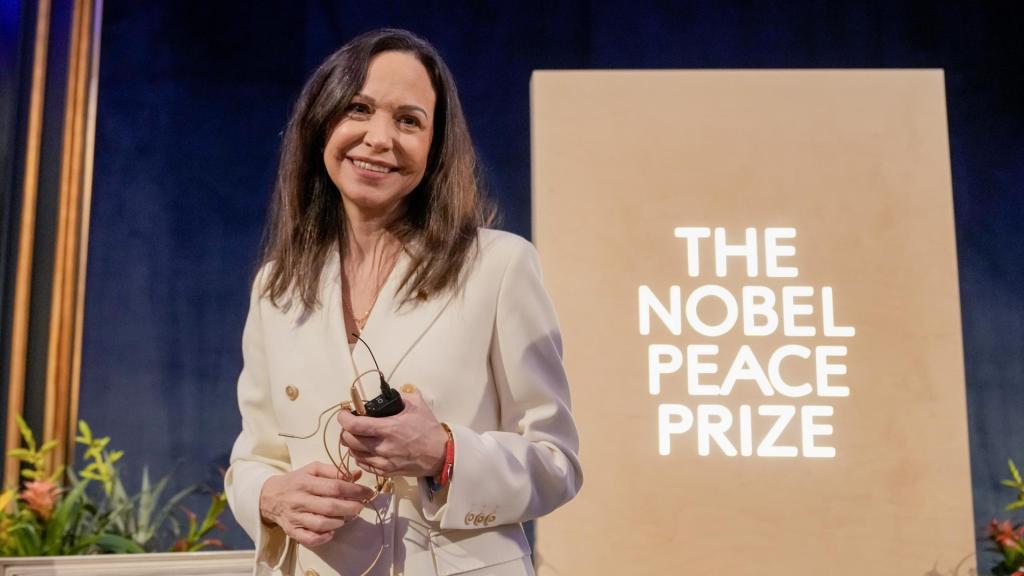
María Corina Machado in her appearance in Oslo after her daughter accepted the Nobel Peace Prize for her.
EFE
The US divides Venezuelans
Outside the Parque Generalísimo Francisco de Miranda, also known as Parque del Este, some teenagers express themselves with greater disdain: “Does she still exist? She made a lot of noise and then nothing,” one exclaims. “We have to focus on our studies, not be aware of politics,” responds another.
A man pushing a cart with two cavas full of soft drinks sums up the feeling of several: “Why should I continue this situation if we go crazy? What I have to do is work.”
Inside the Parque del Este, full of vegetation that encourages visitors, there are people who do not know that they agree in their opinions regarding Machado, despite belonging to opposite positions on the political spectrum.
Alfonso, who testifies under a pseudonym, has dressed to exercise in the park, wearing shorts and a cap, but he enjoys a cigarette that stains his mustache. “The Nobel Peace Prize is incompatible with the promotion of violent foreign intervention, that cannot be the solution,” he says between coughs, without justifying the “disgraceful and repressive regime.”
On the other hand, Jaime, who walks among the trees with a bottle of water hanging from his neck, does not hesitate to describe Machado as “that nefarious being who was born to harm the country.”
“The Nobel Prize is a tool to defend the decadent empire of the United States,” he says, declaring his surprise that those in his neighborhood do not agree with him and support the opponent. “That she says that they are watching her is a show media, but our Government cannot let her continue because she continues to do harm and cannot pursue her anymore because the United States would justify their aggressions and war crimes in the Caribbean, although they should imprison her.”
Rosana, who puts on a sweatshirt to prepare to climb Ávila Hill, justifies the US actions that Machado defends: “Maduro has had a thousand opportunities for dialogue to reach an agreement, and if María Corina supports the situation of the boats, it is because it seems that there is no other option to defend peace and democracy in such a difficult situation.”
When talking about people who ignore the political process, he describes them as “hypocrites who support the Government when they get the food bonus.” “But you will see how everyone positions themselves with María Corina when the Government falls,” he predicts.
Machado has explained that his team has a stabilization plan with a series of actions for the first 100 hours and another for the first 100 days, but so far he has not detailed what he plans to do with the officials and members of the armed and security forces loyal to Maduro.
Fear and silence
Plaza Venezuela is one of the most central points of Caracas, a short distance from the Miraflores Palace, headquarters of the Government of Venezuela, the National Electoral Center (CNE), which facilitated electoral fraud by not presenting the voting records and passed the responsibility of declaring the president to the Supreme Court of Justice, and the Central University of Venezuela, whose students took part in several of the protests bloodily repressed by the military, the police and the paramilitary groups of Chavismo. Several Venezuelans pass by its fountain, some of whom sit down to rest or eat.
Graciela, who prefers to hide her real name, smokes a cigarette with her back to the fountain. As he speaks, he keeps glancing at several Guardians of Caracas, a recently created security force, who are monitoring the unloading of seats for an event. “The Nobel was won in good fight, María Corina has represented all Venezuelans well and it is an injustice that she has to hide in a supposedly free State.”
When he talks about the elections, he hesitates, he uses euphemisms. “I wish the elections could… be finalized, look, it would take… a change,” he says. When one of the overweight uniformed men heads to a food stand near her seat, Graciela gets up and leaves.
Sitting in the shadow of a crane, Yéiber prefers not to express any opinion. “It scares you, and I don’t know who is recording or to whom a stranger is going to say what I say,” he says, waving his hand with a dismissive gesture.
Instead, Brayan stands up to explain himself. “If the award had been here, she couldn’t have received it because there are the bad guys who want to grab her,” he says, pointing to the national guards in one of the CNE buildings, who carry long weapons and gestures of boredom.

The president of Venezuela, Nicolás Maduro, speaks holding the Sword of Peru.
Efe
They are the reason why “she can’t move like you or us, with our crane. Although he keeps pointing out that “she is a politician, like everyone else,” he says he supports her. “But really what I want is for the people there to leave,” he says.
Neither the national guards nor the Caracas guards hear him, they are too far away, and Brayan can continue laughing without being disturbed.