


“Gachó, what a temperature!” That’s the first thing you hear when the curtain rises.
Criminals circulate on stage, but what we see is not the situation created after the dissemination of the well-founded sentence against the attorney general, the arrests of Leire Díez, Vicente Fernández, ‘Antxon’ Alonso and the Plus Ultra domethe confirmation of the prosecution of Ábalos, – already stripped of his rights as a deputy -, the records of the SEPI, Correos or Forestalia and the barrage of complaints of sexual harassment and cover-up that is opening the channel to the PSOE.
Or maybe yes. What a five days.
But it happened that in the herculean conference that the rector of the UCJC, Jaime Olmedorose on Tuesday by hand, fascinating us with two centuries of drifting of culture, he referred to a work premiered in Madrid in 1900 with the title “La Golfemia”.
With that name I couldn’t resist the temptation to search for it, find it and read it.
It is, obviously, a parody of Puccini’s “La Bohemia”—signed by the prolific Salvador M. Granés—, with its pertinent initial references to the icy attic of the protagonists: “Recontra, here God freezes!”
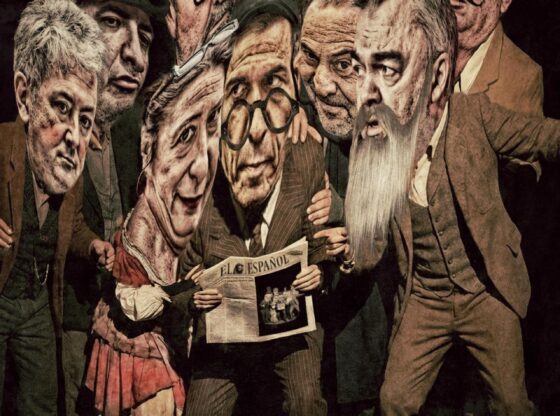
Illustration of the PSOE plumber, Leire Díez, along with other investigated people and Pedro Sánchez.
It would be worth reflecting on the metaphorical coincidence between extreme cold and heat, as expressions of the agony and death of Mimí who, taken as a joke, becomes “la Gilí”.
And the same could be said of any twilight period such as that of the current Spanish politicsbecause everything always happens between the hot flashes of the heart and the wasteland of the souls.
But that was not what seduced me from “The Golfemia”, but the name, activity, affiliation and pretensions of the lover of “la Gilí”.
The transcript of the poet Rodolfo is called – of course – ‘Sogolfo’ and in the fifth scene he makes his self-portrait: “Well, I am a journalist, that is, I sell Heralds on the street.”
In other words, just as much of a journalist as ‘the Plumber’.
And then he adds: “I have my socialist credential for the day when the cataclysm breaks out and while we triumph, one goes away working for the peseta.”
It is true that being a “socialist” 125 years ago meant signify yourself as an apostle of subversion and the bankruptcy of the social order. And that, today, although the symbols endure, the tragedy of history It is only repeated as a farce.
In fact, there are plenty of photos of Pedro Sánchez and other leaders of the PSOE chanting The International with raised fists, without the audience missing some honest naives among the Koldos, the Leires and other ‘sogolfos’ on duty.
This imposed idealism of those who claim, together with their boss, to be “on the right side of History” is the disguise that has been serving as an alibi for both the transgressive bohemia and the voracious opportunism to become an organized golfemia.
That’s right if it seems that way to you. It is time that, at the door of the Ferraz’s office that Ábalos and Cerdán occupied and towards which he was heading Paco Salazar when his fly was casually unbuttoned, someone wrote that motto of the fight for human emancipation proclaimed by ‘Sogolfo’:
“While we succeed, one leaves working the peseta”.
Or the million euros.
***
Twenty more years had to pass for those first golfemia sketches They will sediment in the great premonitory dramaturgy of the putrefaction of current politics.
The director of EL ESPAÑOL right now has in his hands the number 280 of ESPAÑA magazinecorresponding to September 11, 1920. It had been founded five years earlier by Ortega and his successor, Luis Araquistaínintimate with Long Knightoccupied the cover with a feature article in favor of “the workers alliance.”
This imposed idealism of those who claim, together with their boss, to be “on the right side of History” is the disguise that has been serving as alibis.
They followed a text of Comment on Romanones and a report by Álvarez del Vayo about the aborted “soviet republic” in Bavaria. Closing the issue, two pages with the sixth installment of “Luces de Bohemia” by Ramon del Valle Inclansubtitled week after week with a word that no one had promoted until then: “Esperpento”.
In that sixth installment is the one in which the blind poet Max Estrella He is going to complain about the poor police treatment to his old co-religionist, the unnamed ‘Minister’, who gets out of trouble with an ‘overwhelming’ subsidy: “Every month they will take your money to your house.”
Then, Max without hesitation crosses the border between bohemia and golfemia: “Know that you give me money and that I accept it because I am a scoundrel. I was not allowed to leave this world without having once touched the bottom of the reptiles.”
The previous description says that in the room “there are bad pictures, apparent and provincial luxury”, but it does not clarify whether the scene takes place in Development, Industry, Ecological Transition or in Moncloa itself.
And the alternative is left for our imagination if in reality was not ‘Max Aldama’, ‘Max Antxon’ or ‘Max Fontanera Díez’ whoreversing roles, brought the envelope corresponding to His Excellency.
On behalf of their clients of masks, hydrocarbons or renewables.
***
In the famous final dissertation on Gato’s Alley, Max Estrella himself refers unknowingly to Pedro Sánchez: “The classic heroes reflected in the concave mirrors give the I’m waiting…with a systematically deformed aesthetic.”
That is what remains, week after week, of the Peugeot hero, the “no means no” herothe hero of the reconquest of power, the hero of the motion of censurethe titan of resistance.
There it is, distorted, made into a grotesque filth in his ice palace, after having walked through Cat Alley, from top to bottom, from bottom to top, lie after lie, hypocrisy after hypocrisymirror after mirror.
Let’s just look at three milestones on his journey. Let’s see it in front of the first concave mirror. He said “I will bring Puigdemont back” from prison and soon exchanged his investiture for that amnesty that, according to him, was contrary to the Constitution.
It was a journey in which even the law and constitutional justice were turned into two more absurd characters. Those that the day before yesterday were serious crimes against the integrity and state security today they continue to be bleached like groupers cyclical effects of a deep “unresolved political conflict”.
The second deformation in front of the glass is being spectacular wherever it exists. She spoke again and again about feminism – perhaps learned, as she says Feijóoin his father-in-law’s brothels—and now what we can see is a reverberation of denunciations by harassment with epicenters in Moncloa, Ferraz and other branches.
What Cat Alley is all about. We have traveled from the erasure of women at the request of Podemos to the cover-up of Salazar and his emulators, passing through political romance, with its corresponding relapsebetween “el Guapo” and “el Putero”.
In “Bohemian Lights” Madam Collet and Claudinita They are intelligent and sensible women with no possibility of thriving in the public space, “collateral victims” of male golfemia. Decorative figures in a machirulo world like some of the most valuable socialist figures are today.
We have traveled from the erasure of women at the request of Podemos to the cover-up of Salazar and his emulators, passing through the political romance, with its corresponding relapse, between “El Guapo” and “El Putero”.
The focus of the grotesque moves towards “La Lunares”, “Enriqueta la Pisa Bien” or “la Vieja”. The ups and downs of the moment. prostituted women to satisfy primary appetites. One hundred years later they are spoken of as “Vanderleia Aparecida”, “Ofelia Stoica” or “the Carlota who roll up what shit”.
Women reduced to their bodies, placed on the margins, turned into objects for the use of men, on the agenda of the Minister’s advisor. Do we live in the 21st century under a government that calls itself ‘progressive’?
The third sequence shot shows us Sánchez looking at every Spaniard in the eyes in the middle of the darkness. He is a “clean politician” who leads “an exemplary party” and did not know anything about those “few specific cases” of corruption that “cannot stain the rest.”
Little by little the mirrors that surround him turn on and in each one of them – at this rate we will reach the 357 in the famous gallery of Versailles – his face appears. becomes a new ministersenior official or socialist leader accused, investigated or under well-founded suspicion.
Is it not faithfully fulfilled today that, as Valle wrote in that same scene“Spain is a grotesque deformation of European civilization”?
At least the Spain of Pedro Sanchez.
***
Let’s review some more quotes from “Bohemian Lights”, in Tribute to my great friend Ignacio Amestoypromoter for a quarter of a century of that secular pilgrimage that is “the night of Max Estrella.”
“In Spain, merit is not rewarded. rewards stealing and being shameless. “Everything bad is rewarded.”
Let’s put the thieves aside for the moment, because maybe they’ll stay at 40, and let’s look at the casting of Ali Baba. If we review the composition of the Council of Ministers and the executives of the PSOESince Sánchez came to power, mediocrity and shamelessness have been, with honorable exceptions, the dominant standard.
“To thrive you have to be pleasant… In Spain the work and intelligence They have always been looked down upon. Here everything is ruled by money.”
These are, today more than ever, the two scales in force.
First of all, if Tezanos didn’t give the PSOE nine points advantage in voting intention, when the average of the other polls is on the path of the inverse forecast, it would not follow the front of the CIS. And what can we say about what happens on RTVE?
On the other hand, if those of us all who know had not bribed Ábalos and probably someone else with access to the president, the lifeline of public money It wouldn’t have arrived in time. That’s why the bills flew quickly into envelopes and plastic bags.
If those of us all know had not bribed Ábalos and probably someone else with access to the president, the lifeline of public money would not have reached them in time.
“Our life is a Dantesque circle. Anger and shame”.
The tragic feeling of life, the feeling that there are very serious things that have no remedy, once again dominates the Spanish scene.
All that remains is to hope that in our era poetic justice is exercised by the ballot boxes in time. At least in time to prevent the cynical Don Latino from stealing the winning lottery number from him again. Max Estrella —Max España— While dying on a frozen night like these, under the sky of Madrid.
With that hunch, today’s journalist reviews the collection of the SPAIN magazine. The editorial that opens issue 279 is titled “Symptoms of Corruption”.
Its first lines say: “Spanish politics has been agitated for some time to this day under the threat of pernicious constellations.”
And the last ones conclude: “The Spanish political altarpiece, from the highest to the lowest, accentuates a nuance of impudence that is a serious sign of rapid decomposition”
A few pages away diagnosis becomes prognosis: “The political crisis has arisen. The liberals are preparing to conquer power.”
Let it be so this time.