


Many of us are passionate about Thomas Hirschhorn (Bern, 1957), he leaves no one indifferent. After the loss of Helga de Alvear, a cycle of exhibitions of artists very loved by the collector, with a strong personal imprint and a direct connection with current audiences, has been scheduled at the Museum of Contemporary Art of Cáceres. After Santiago Sierra, now comes the Swiss Hirschhorn with whom the museum director Sandra Guimarães has made an anthological exhibition.
The idea suggested by the curator of creating an Atlas, following the inspiration of the Atlas Mnemosyne (1924-1929) by the German art historian Aby Warburg, on which Hirschhorn has worked for the last two years, has allowed him to articulate some of his small pieces belonging to the collection, as well as the large installation Power Tools2007, now expanded with the activation of a workshop, in addition to the recent and overwhelming installation Fake it, Fake it – till you Fake it, 2024, which we can enjoy for the first time in Europe. To which is added, as usual, in the entrance atrium of the Casa Grande, the old Foundation, the very caustic and almost minimal Gravity, Mass and Democracyfrom 2025.
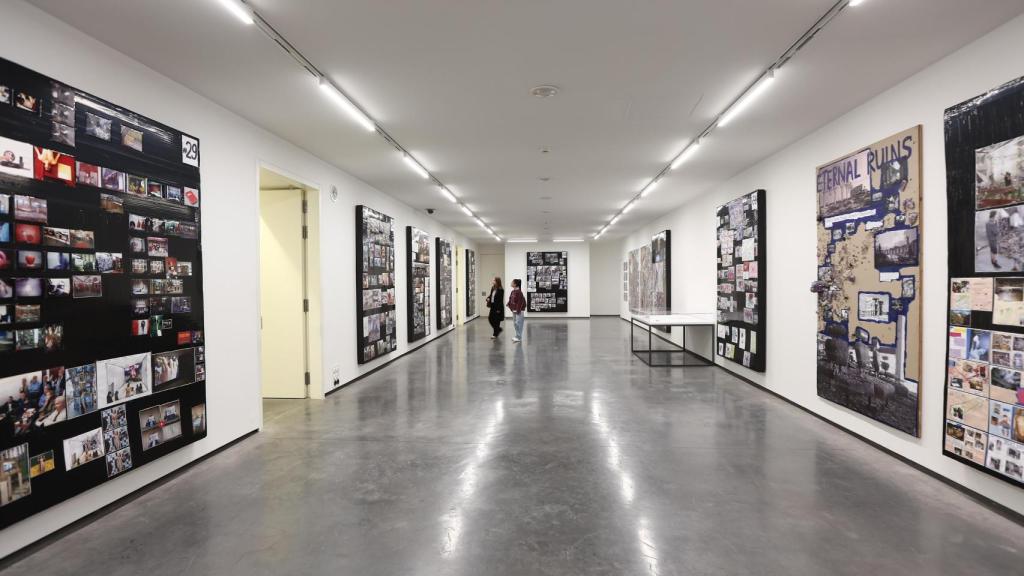
I have doubts about whether My Atlas (2025) has been a good idea. Forty-five huge panels Built with their usual materials, cardboard covered in black plastic and overlapped with all kinds of documents: photographs, drawings, plans, etc., they occupy all the rooms of the Casa Grande.
No chronological orderexcept for the first one that alludes to its graphic beginnings in Paris in the 1980s, each panel places emphasis on materials, processes, references and experiences. But not even the free guide published for the occasion encourages you to stop at each and every one of them.
I understand that, upon reaching a certain age, everyone, especially an artist, is tempted to make a recount. And it is not that the unorthodox image associations of the Atlas Mnemosyne Hirschhorn’s actions go badly. but everything in his work he is so explicit that it doesn’t seem like there is anything very special to discover and that can replace the physical occupation and perception of your work, which are essential.
View of the Thomas Hirschhorn exhibition. Photo: Jorge Armestar / Helga de Alvear Museum
Nor do I think it would be convenient for such a peculiar artist, much less at this point, to spend his time on hackneyed aesthetic deconstruction of archival art. Even, although in opposition, it reminds us of the orderly Atlas of the famous and sought-after painter Gerhard Richter, in its antipodes, assimilating it to that ‘so German’ procedure.
Possible contradictions that Hirschhorn has sought to avoid by adding Our Atlas in the title of the exhibition, suggesting its intention to propose to each visitor creating your own atlas.
Its installations are welcoming, empowering and cathartic. What a great expedition it is to revisit ‘Power Tools’
However, the annexes to these panels are of great interest, pieces placed on the floor and hanging on the wall, as well as drawings and many of the artist’s notebooks in display cases. Some had never left their studio. Hirschhorn insists again and again with drawings and diagrams on his anarchist ancestry and in that irrational root that intimately links him to Nietzsche and the so-called neo-nietzscheans Foucault and Deleuze. Without a doubt, an inexhaustible source, anti-system and radically critical, whose imprint radiates energy everywhere.
Its facilities are cozyempowering and cathartic. What a great expedition it is to retrace the now expanded one with a workshop Power Tools-Workshopthat seemingly labyrinthine cardboard hardware store with all kinds of physical and intellectual tools, whose composition and construction process can be analyzed in panel 32.
Thomas Hirschhorn: ‘My Atlas’, 2025. Photo: Jorge Armestar / Helga de Alvear Museum
Without such indications being able to emulate even for a moment the experience of the waste of resources, the sincere and direct proclamations on small posters and large banners: “quality is better than quantity”, “concentrate on something”, piled up “love”, “love”, “love”… And about the workshop: “here you have tools to create your own power”.
On the shelves of the bookstore, a lot of philosophy, from Plato to the thinker of affections Spinoza and Bataille; and literature, cinema, art theory; but also, popular newspapers and magazines. Nobody is excluded. But yes invoked without escape to take commandlike a child when he plays his adventures without fear, in this magical enclosure, so material and dreamlike.
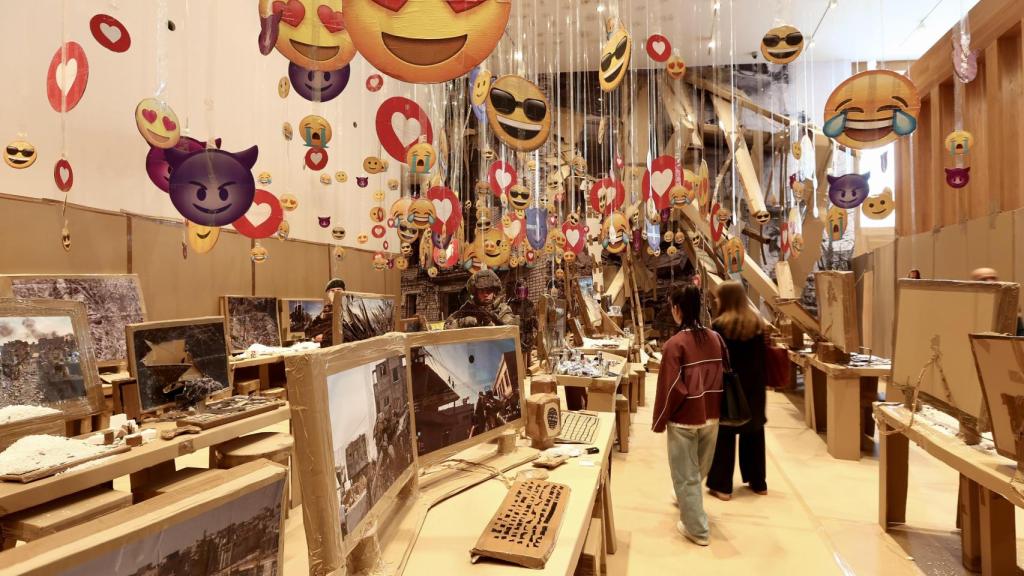
The other great installation Fake it, Fake it – till you Fake it (finge hasta que lo consigas)only previously shown at the New York gallery Barbara Gladstone, is a response to “how to make art in times of warviolence, fear, hatred, resentment?”, in the words of the artist.
For those who travel through it, it can be a catharsis of the helplessness we suffer when faced with images that we see on screens every day. In this case, Hirschhorn has reduced our universe to a large room of tables with computers, but we also find other phone and laptop screens on shelves with snapshots of wars.
View of the exhibition. Photo: Jorge Armestar / Helga de Alvear Museum
In addition, on the tables there are work cups, ashtrays and supplies for snorting drugs, while emojis of faces hang from the ceiling saturating this toxic space. It is very liberating to stand in front of bursting screenswith the images shattered into sharp splinters jumping from the monitors.
Of course, all cardboard, aluminum foil, packing tape… a material and analogical precariousness akin to the vulnerability of the existential collapse that we are experiencingalmost like entelechies under the threatening empire of AI, an authentic transcript of this installation.
Does its replacement make us unable to understand the world and act? The answer can be found in an annex to panel 41: in the tribute to Simone Weil he quotes “everything that is an act of intelligence is intuition”