

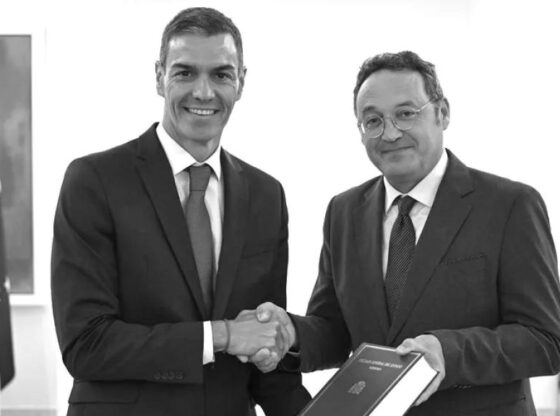

The Supreme Court published this Tuesday the full sentence that condemns the former State Attorney General, Alvaro Garcia Ortizfor a crime of revealing secrets.
The resolution, 233 pages long and supported by five of the seven judges who tried the case, presents a solid, coherent and conclusive legal basis that dismantles the accusations of arbitrariness launched by the Government and its allies.
The sentence also shows a burden of proof higher than that of many other convictions that have never been questioned so vehemently by those who now shout “lawfare”.
The conviction is based on two pillars.
First, the leak to the SER of the email of February 2, 2024, in which the lawyer of Alberto González Amador He recognized that his client had committed “certainly two crimes against the Public Treasury” and requested a conformity agreement.
The Supreme Court considers it proven that this information was communicated from the State Attorney General’s Office “with direct intervention, or through a third party, but with full knowledge and acceptance by Mr. García Ortiz” to the journalist. Miguel Angel Campos.
The literalness with which the SER reproduced the content of the email, the temporal synchronization between the receipt of the document by the attorney general and its media dissemination, and the absence of any reasonable alternative make up an evidentiary picture that the court itself describes as “solid, coherent and conclusive.”
Second, the official information note that the State Attorney General’s Office released on March 14, written under the express instructions of García Ortiz, who even dictated some of its passages.
The attorney general himself was proud of this authorship at the time, publicly defending its content as a legitimate exercise of institutional transparency.
However, the Supreme Court emphasizes that this note incorporated data that should not be disclosed due to its confidential nature and its direct impact on the presumption of innocence and González Amador’s right to defense. who had not yet been judged.
The sentence recalls that the attorney general had “a reinforced duty of confidentiality that he violated without justification.”
The Supreme Court directly rejects the defense argument according to which the note was aseptic and the data was already public.
With legal clarity that is difficult to refute, the ruling explains that the Public Prosecutor’s Office cannot rely on previous leaks (of unknown or illicit origin) to repeat and amplify, with the institutional seal of the Attorney General’s Office, the disclosure of protected data.
Why’s that The institutional position of the attorney general is not equivalent to that of a media outlet. His word has binding and legitimizing force, and turns mere information into an “authoritative story” with devastating legal and reputational consequences.
The Government’s reactions to this ruling are as revealing as they are worrying.
The ministers Oscar Puente y Oscar Lopez have publicly mocked the sentence, while the PSOE spokesperson, Montse Minguezhas alluded to a “new legal concept: unfiltered filtration”, forgetting that article 28 of the Penal Code punishes both the direct perpetrator of a crime and the mediate perpetrator.
The President of the Government, for his part, has come to demand that it be Ayusoand not the attorney general, who apologizes, in an obvious attempt to distort reality and turn the convicted criminal into a victim… of his own victim.
This ridicule of the Supreme Court ruling is not a legitimate exercise in political criticism, but rather a calculated strategy to undermine its legitimacy and prepare the ground for an eventual rectification by the Constitutional Court.
Government sources have hinted that they trust that the TC, with its current progressive majority, agree with García Ortiz when he presents his appeal for protection.
The precedent of the ERE, where the Constitutional Court annulled the Supreme Court’s convictions of the former Andalusian socialist presidents by seven votes to four, or that of the Amnesty Law, weigh on this calculation.
The underlying question is inevitable. Can a court questioned due to its partisan composition acquit someone who was appointed attorney general by the same Government that renewed that court?
The legitimacy crisis of the Constitutional Court, aggravated by recent decisions that have reinforced the perception of politicization, would reach unprecedented dimensions.
The separation of powers, a basic principle of the rule of law, would also be definitively compromised if Pedro Sanchez managed to get the Constitutional Court to annul, once again, an adverse decision of the Judiciary.
The systematic recourse to the concept of lawfare by the Government and its parliamentary partners also constitutes a direct attack on judicial independence.
Accusing the Supreme Court of carrying out “judicial warfare” against the Executive for condemning an attorney general who broke the law is perversely inverting the terms. He lawfare It is not that judges judge those who commit crimes, but rather that political power instrumentalizes justice to persecute political adversaries.
The Supreme Court ruling is not, in short, an exercise in argumentative creativity, but rather in legal rigor. Its evidentiary basis is superior to that of many other convictions that have never been questioned with such intensity.
That the Government tries to delegitimize it through mockery and disqualification reveals its true conception of the Rule of Law. Useful when it favors your interests, dispensable when it contradicts them.