

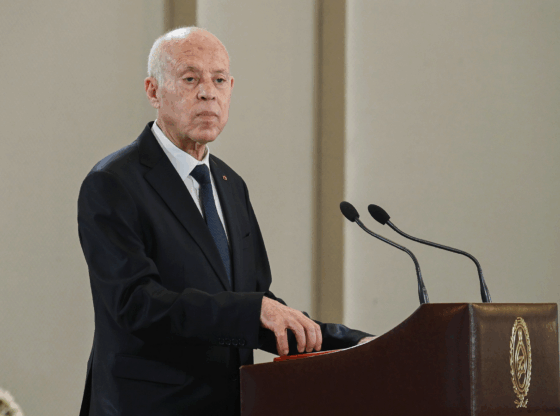

The tension between the European Union and the Tunisian government may be evidence of differences between the two sides, but it does not mean that Brussels is seeking to force President Kais Saied to promote human rights and carry out political reforms, analysts say.
This dispute worsened and reached its peak recently when the European Parliament issued a statement calling for pressure on Saied and linking economic relations with him to improving the issue of political rights and freedoms, which the latter considered unacceptable interference.
Saied also summoned the European Union ambassador to his country, Giuseppe Perrone, and informed him of a strong protest against what he considered a “violation of diplomatic norms,” after a meeting between the Western official and the Secretary-General of the Tunisian General Labor Union (the largest union organization in the country), Noureddine Taboubi.
Analysts do not believe that the issue of rights and freedoms is the main driver of the growing dispute between the two historical partners, and they say that something undeclared is driving these tensions.
According to the 12/4/2025 episode of the “Scenarios” program, the European Union is Tunisia’s first trading partner in the field of energy and other fields, as it owns 88% of direct foreign investments on its territory.
More importantly, the two parties signed an agreement two years ago, the majority of its provisions remained secret, and human rights organizations say that the Tunisian government assumed responsibility for guarding the northern Mediterranean maritime borders and preventing the flow of further waves of irregular migration.
President Kais Saied denies accusing him of tackling immigration on behalf of Europe in exchange for limited financial privileges, but Italian officials have repeatedly praised Tunisia’s role in reducing the number of migrants, which organizations say have increased remarkably on Tunisian territory, after the signing of the agreement.
Interest is more important than principles
Therefore, this tension between the two sides does not mean the Europeans’ desire to improve the political and legal situation as much as it reflects their fear that the internal crisis will worsen in a way that will push thousands of Tunisians to knock on Europe’s doors, says Hamza Al-Maddeb, a researcher at the Carnegie Middle East Center.
It is true that human rights represent the basis of relations between the two sides, but they are not a priority – in Al-Madeb’s opinion – if they are placed before the issues of energy, securing coasts, and enhancing the ability of European governments to confront irregular migration.
But the real problem for the Europeans is that they see Saied as an irrational partner, and therefore they are concerned that any Tunisian internal explosion will lead to an increase in immigration rates instead of reducing them, according to Al-Maddeb.
As for journalist Mohammed Al-Yousfi, he believes that ambiguity surrounds the current dispute between Said and the Europeans, who he believes have used Tunisia for free to prevent immigrants from arriving in their country.
Al-Yousifi attributes the Tunisian president’s anger to the possibility of the Europeans reneging on the economic promises they made to him when they signed the agreement, which he says “they held a press conference to celebrate without the presence of journalists, and this reflects a violation of the freedom of the press by both sides.”
In fact, the European Union signed the agreement, which Saied did not subject to a constitutional debate or present to the Tunisian Parliament. Therefore, their current talk about political rights and freedom of expression does not seem serious, in the opinion of Al-Youssoufi, who believes that this debate will not change the existing political situation.
The spokesman also quoted a Western official as saying that European leaders began communicating with the Tunisian president through Italian Prime Minister Giorgia Meloni, who was the godmother of the agreement to limit immigration, considering this “evidence of an undeclared disagreement over matters that do not include the file of rights and freedoms.”
Concerns about the immigration problem
European affairs expert Daniel Boehmer agreed with the hypothesis that Europe will not affect the Tunisian political situation, but he said that it will not accept Tunisia’s bankruptcy because it is the closest to it in the Maghreb region.
Boomer disagrees with Al-Youssoufi and Al-Madeb’s talk about Kais Saied providing free services to Europe by saying that he obtained $100 million from the immigration control agreement to support his budget, in addition to obtaining initiatives in the fields of energy and steel.
However, Brussels does not deal with Tunisia as an economic partner, but rather as an important security partner in confronting migrant flows, according to Baumer, who said that the anger of the (popularly elected) European Parliament will not change anything, because the Union Commission (which is chosen by governments) is the decision-maker, and it puts interests before human rights in its dealings with Tunisia.
Since European governments are the decision-makers, not Parliament, as Daniel Boehmer says, they “will continue to support Kais Saied’s authoritarian regime, and will not support any political change soon, as long as it helps them win the elections by confronting the immigrants who represent a political burden on them.”
However, Al-Youssoufi describes this as “incorrect,” and says that the majority of the budget comes from within and not from Europe, which tried to reduce the immigration problem by exporting it to Tunisia, which Al-Maddeb described as “a country without a project that accepts what is offered to it, and does not try to exploit its strengths, or reposition itself globally.”
Among the things that motivate Said not to seek a new position with countries such as China or the Arabian Gulf is “that he wants unconditional relations, without talking about any internal reforms,” according to Al-Maddeb, who expected tension in relations between Said and Europe without any actual change, which is something Al-Youssoufi agrees with.
Al-Maddeb concluded by saying that Beijing believes that this regime is unable to crystallize a future vision, and that it is incapable of creating internal alliances even with those who supported its coup, while it continues to deepen its external isolation and is content with playing the role of guarding the European coasts instead of trying to create partnerships even in the Maghreb region.
Published On 5/12/2025
|
Last update: 01:28 (Mecca time)