

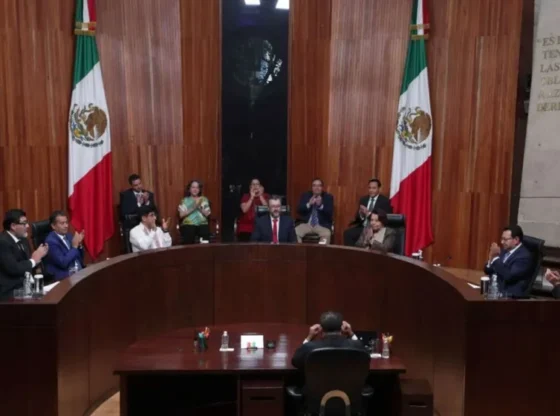

The magistrate of the Superior Chamber of the Electoral Tribunal of the Judicial Branch of the Federation (TEPJF), Claudia Valle Aguilasochocalled to adopt tools such as catalogs of traditional authorities and adjust requirements to guarantee authentic indigenous political participation in accordance with their community reality.
Valle Aguilasocho stated that the next electoral reform must place the participation of the indigenous and Afro-Mexican peoples and communitiesexpanding visions and strengthening the avenues of representation that continue to be insufficient to guarantee their full participation.
You may also be interested in: TEPJF confirms fine to the PRI for failing to comply with gender parity
During his speech at the Chamber of Deputiesin front of representatives of the INE and different state judicial powers, recalled that the constitutional reform of September 2024 recognized the indigenous and Afro-Mexican peoples as subjects of public lawwith legal personality and own assets. He explained that this new status must translate into decisions made within the communities having full legal effects, both inside and outside of them.
Before the next reform, it is essential to open spaces
He stated that, before the next electoral reformit is essential to open spaces, strengthen avenues of participation and guarantee that peoples and communities can build their political-electoral agenda in an active and plural way.
He pointed out that the center of the reform must focus on opening spaces; which implies strengthening both the internal election processes for community authorities such as access to state decision-making spaces.

One of the axes of his participation was his proposal to consolidate the catalogs of traditional authorities as national public policyinstruments already implemented in Oaxaca and Hidalgo that allow recording who the legitimate authorities of each community are and what their current practices are.
He indicated that these catalogs reduce internal conflictsprovide certainty to state institutions, facilitate consultation processes and allow real indigenous representation in city councils. He clarified that these instruments should not condition collective rights, but they do strengthen the legitimacy of community authorities and improve the interaction between people and the State.
Existence of indigenous or ethnic political parties
In a second axis, the judge Claudia Valle addressed the possibility, already present in other countries in the region, that the Mexican electoral system contemplates the existence of indigenous or ethnic political parties.
He explained that it is not about increasing the number of parties, but about allowing historically excluded communities to exercise their political rights under fair conditions.
You may also be interested in: INE cannot request reimbursement of remaining party financing: TEPJF
He proposed that, If an indigenous community seeks to establish a political partythe requirements must be equivalent to their demographic reality and not a copy of the requirements designed for traditional parties. He detailed that the number of assemblies and the required percentages must be proportional to the indigenous population of the corresponding state.
“If I seek to establish an indigenous party, I can only be required to have a percentage equivalent to the actual indigenous population of the state,” he said. He added that This adjustment is necessary to guarantee legitimate indigenous representationaccording to their own forms of organization.
In closing, he recalled that Mexico is a multicultural and intercultural nation and that The ongoing electoral reform represents an opportunity to consolidate inclusive mechanisms and culturally relevant that recognize the diversity of the country’s peoples and communities.