


With the publication of the agreement that reinforces the National Animal Health Emergency Device (Dinesa) to contain the cattle screwworm (GBG) in Mexicotoday new actions were launched to control and eradicate this pest in the country.
In a statement, the Ministry of Agriculture and Rural Development (Sader) reported that today it was published in the Official Gazette of the Federation (DOF) the agreement that expands the measures to prevent, control and eradicate myiasis caused by GBGwith the support and collaboration of all sectors related to livestock production and, likewise, the population in general.
READ: First case of cattle screwworm confirmed in Jalisco
The agency explained that said instrument is mandatory for the Agricultural Development Secretariats of the States, the owners, managers or possessors of animals susceptible to the plague; official and freely practicing veterinarians, livestock importers, certification bodies, testing laboratories, auxiliary animal health bodies, people who enter and transit the country in the company of susceptible animals, as well as vehicles containing goods that come from or have transited through countries or regions with GBG outbreaks.
All these subjects are obliged to notify any type of worms to the staff of the National Agri-Food Health, Safety and Quality Service (Senasica), a key organization in the strategy for the prevention, control and eradication of the cattle screwworm at the national level.
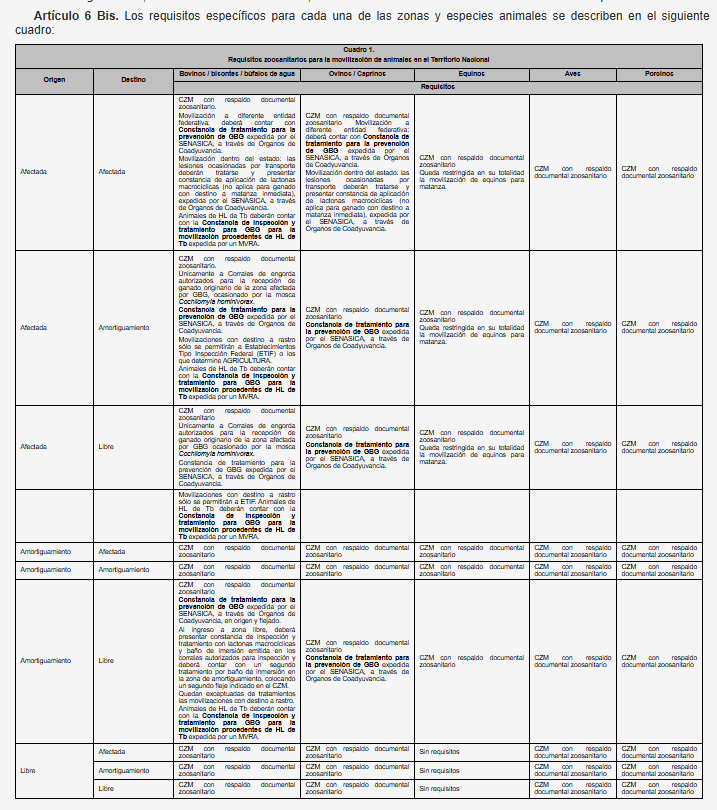
Starting today, mobilizers of cattle, buffalo, bison, sheep, goats, pigs and birds must comply with the provisions of the applicable legal provisions and present the Zoosanitary Mobilization Certificate (CZM) for any transfer of animals.
Animals should be treated with antiparasitics three to five days before managing CZM.. After treatment and prior to mobilization, the cattle must be bathed by spraying or immersion with an insecticidal product with a larvicidal effect and will be subject to physical inspection, in order to rule out the presence of wounds and worms.
Under no circumstances should animals that are unable to stand, sick, fatigued, injured or infected with worms be moved in order to mitigate the risk of dispersion of the GBG fly.
Animals with wounds must be treated by their owners, with the support of insecticides with larvicidal and healing action.e, and remain in the livestock production unit or collection center of origin until the wounds are completely healed.
For all mobilizations originating in an affected area, the CZM must be established. Federal Verification and Inspection Points (PVIF), Internal Verification and Inspection Points (PVI) and Emerging Verification and Inspection Points (PVIEM) through which the cargo will transit for inspection or treatment.
For more information, see here
EE