


In 2007, in the opening drunkenness that the 2008 Beijing Olympic Games represented for China, the Government then chaired by Hu Jintao presented his flagship project for Everest. First he would build a highway to the northern base camp of the world’s tallest mountain, then a hotel with a spa, a museum and a helipad. At 5,150 meters above sea level, a holiday city. The political ups and downs in the country and the protests in Tibet between 2010 and 2012 caused the plans to shrink – the first stone of the building was not even laid. resort-, but a track was also paved from the city of Shigatse to the foot of the Himalayas. The result?
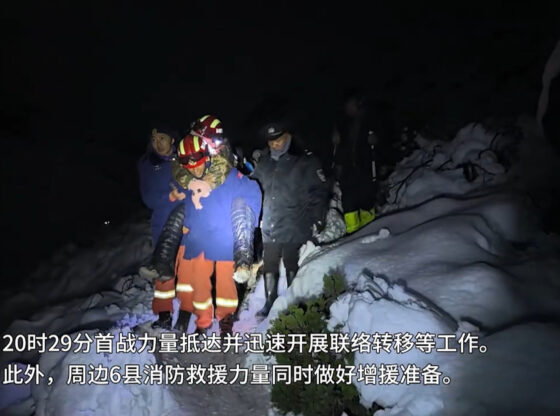
Last Friday, a storm surprised more than 500 hikers on the paths between Everest and Cho Oyu, and rescue efforts were carried out for several days, with one death to mourn. It was a tragedy, a concatenation of adversities, but above all it was the demonstration that it is not necessary to step on the roof of the world to be in danger. Just get closer.
«China built infrastructure with the intention of controlling Tibet, it began to bring the majority ethnic population to live there and set up a kind of tourist theme park around Everest, Cho Oyu, Makalu and Lhotse, the four ‘eight thousand’ in the area. During festivities such as Golden Week, its Holy Week, thousands of Chinese hikers without experience or acclimatization set out at 5,000 meters of altitude with a windbreaker and city shoes. And then two meters of snow falls in a storm and what happens happens,” he says. Sebastian Alvaromountaineer, writer and director of On the edge of the impossible on TVE for 27 years, who knows the area well because he filmed a documentary there about the mythical expedition of George Mallory y Andrew Irvine in 1924.
EFE
According to his calculations, the official information that speaks of the rescue of hundreds of people in just 48 hours must be imprecise because “there is no high mountain equipment there.” “We will never know what really happened,” he points out. “From Tingri, the closest town, they sent a few firefighters who have no experience and who are outnumbered by all the people who go to the northern base camp of Everest,” analyzes Álvaro. And the data proves him right.
Half a million visitors
As the Chinese Government itself boasts, last year it exceeded half a million visitors for the first time in what they call the “Everest scenic area”, an exaggerated number. Although it has an area double that of Spain, Tibet barely has three million inhabitants and its public services are minimal. There are no figures for accidents – much less deaths – but it is very possible that there have been previous misfortunes in the region.

AFP
Far from the global indignation caused by queues on the roof of the world, in recent years walks around the base have multiplied and, with them, the dangers. «On the Chinese side of the Himalayas there is a plateau that has hardly any vegetation and in the country’s tourism agencies it is sold as a friendly area for hiking. The Chinese go there with very little awareness and very little preparation. And, suddenly, they find themselves at 5,000 meters. “You have to think that the highest peak in the European Union is Mont Blanc, which is 4,800 meters,” he emphasizes. Sergi Unanueowner of the Mundo Recóndito agency, resident of Beijing for a year and author of the book A path through the cloudson the Great Himalayan Route. «There is a very obvious risk in making such extreme areas of the world so accessible. The Chinese side is not talked about as much because not so many foreigners travel, but it also happens on the Nepalese side,” adds Unanue.
Move the base camp, mission impossible
In the southern Himalayas, in Nepal, activity has also intensified at the foot of the great mountains, although no tragedies have been reported since the avalanche that in 2015 caused the death of 22 people at the southern base camp of Everest. Every year, between three and five deaths are reported due to cerebral edema caused by altitude sickness, but the accident rate is low if one takes into account that about 30,000 mountaineers visit the area annually. Although there are already many of them, Nepal will hardly experience the extreme touristification that occurs in China. The budgets of the two countries have nothing to do with each other, the orography of both areas is very different and tourists come from different places.
In the Nepalese area, while the travel agencies that run the sherpas They consider that the business is at the heights, the draws to the southern base camp are mostly organized by foreign companies and their clients arrive more prepared. They tend to be well informed, have advice and help from these companies in terms of material or food and normally invest enough time to acclimatize – between 10 and 12 days to do the route.
This winter, the Government of Nepal, chaired by Ram Chandra Poudelannounced that the so-called “highway to Everest” had been completed, and numerous international media published it, but it was still a runway between Kathmandu and Surke, near Lukla, a journey that tourists already used to take by small plane. In principle, the area is safer, although the threat looms over the southern base camp in the form of melting ice. Due to global warming, the Khumbu glacier continues to fracture and this increases the danger to the camp. There is a project to move it 300 or 400 meters lower, but there is a lack of budget and logistics. You don’t have to step on the roof of the world to be in danger. Just get closer.