

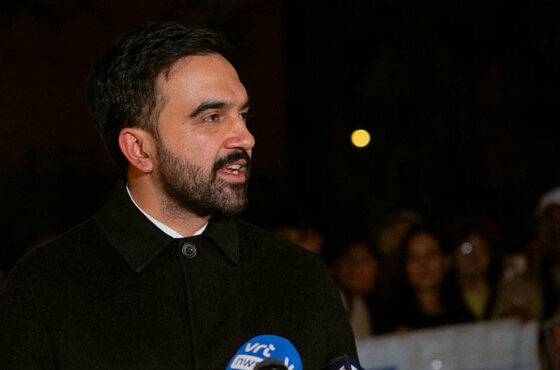

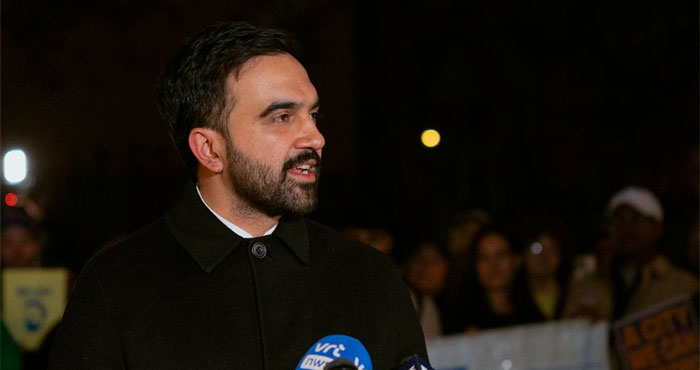
A socialist, migrant and Muslim is the new Mayor of New York, the key city of the United States and of world capitalism. His name is Zohran Mamdani, and he is just 34 years old. The young politician who had little experience as a state assemblyman, twice defeated the experienced (and crafty) Democratic politician Andrew Cuomo. First in the Democratic Party primaries in June and in the general elections on November 4.
Mamdani’s campaign was so successful that New Yorkers went out to vote as they had not done since 1969. More than two million voters went to the polls and more than half gave their vote to this young man trained in the Association of Democratic Socialists and who has Bernie Sanders as a mentor. That’s right: a socialist will govern one of the world’s major cities starting January 1, 2026.
His victory represents, without a doubt, a turn in United States politics marked until now by the conservative, right-wing and fascist policies of President Donald Trump in his second term. Along with Mamdani’s victory in New York, the Democratic Party won in the state of Virginia, with Abigail Spanberger, and in New Jersey, with Mikie Sherrill. Other Democratic candidates won other important mayoralties such as Buffalo. Meanwhile, in California the Democratic Party won the elections two to one and imposed a referendum on electoral redistribution in that important state, which gives the Democrats the possibility of winning up to five more seats in the House of Representatives, and thus compensate for a similar move that the Republican Party had carried out in Texas. The Democratic victory in California confirms the chances that Governor Gavin Newsom will become the party’s presidential candidate for 2028.
Taken together, Mamdani’s victory in New York and in other Democratic seats represents a political defeat for Donald Trump and his MAGA movement (Make America Great Again) because without a doubt Mamdani and his political platform represent just the opposite of the Trumpist political base. I wrote it at the beginning: Mamdani is a migrant born in Kampala, Uganda to Hindu parents, he is Muslim and openly declares himself a socialist (Trump calls him a “communist, Marxist”). Furthermore, he clearly and openly spoke out in favor of the Palestinian civilian population, condemning the genocide that Israel committed in Gaza and declared that, if he won the Mayor of New York, he would do everything in his power to arrest the Prime Minister of Israel, Benjamin Netanyahu if he ever set foot in this city. This is a risky political move when it comes to New York, where the largest Jewish population lives outside of Israel. Despite this, many young New York Jews joined Mamdani’s campaign.
What led to the victory of a young politician with little experience and without the support of the aging political structures of the Democratic Party and with the rejection of the billionaires who live in New York and who are traditionally the power behind the throne in the headquarters city of Wall Street?
According to analysts, it was a refreshing campaign on social networks and grassroots work close to the inhabitants of New York, especially the working class, to whom Mamdani listened carefully. As soon as he announced his candidacy for the Democratic Party primaries in October 2024, Mamdani went to the traditional neighborhoods of New York, such as Queens where he lives and Brooklyn, to ask on the street why some voted for Trump and what their main concerns were. As a result, many voted for Trump not so much because they agreed with his conservative project but because of the rising cost of life in New York.
With these inputs, Mamdani and his young campaign team launched a simple but clear political program: make New York an affordable city for the entire population, especially for the poorest and not just for millionaires. And specifically, he offered that if he won the mayor’s office he would commit to these measures: freezing the rent for four years on one million homes, offering public (and improved) transportation to the entire population, and free and universal childcare. And all of this would be paid for by increasing taxes on New York millionaires.
Part of Mamdani’s success in this campaign has been precisely his message, considered radical by many. Unlike many politicians in the world, and particularly Democrats in the United States, Mamdani did not go to the center of the political spectrum in this campaign. On the contrary, he adopted a radical discourse to put the needs of the working class, the poorest and immigrants at the center of his political program. This is what he said on October 13 at a rally held at the United Palace: “We believe that, in the richest city in the richest country in the history of the world, workers deserve a decent life.”
His campaign speech also had direct criticism of the billionaires who believe they own New York. At that same Oct. 13 rally, Mamdani said: “We are an existential threat to billionaires who think their money can buy our democracy. We are an existential threat to a broken status quo that buries workers’ voices under big business. And we are an existential threat to a New York where a day of hard work is not enough to earn a good night’s rest.”
Despite this public speech, behind the scenes Mamdani sought rapprochement with some of the city’s billionaires to convince them that an eventual government headed by him did not represent a threat to the capitalist class.
After his surprise victory in the Democratic primary on June 24, Mamdani sought private rapprochements with some key figures in the city such as former New York mayor and billionaire Michael R. Bloomberg, as well as Larry Fink, executive director of the investment fund BlackRock, and Hamilton E. James, former director of Blackstone, according to a report by the New York Times (November 4, 2025).
He even made concessions to the real estate sector, since at the beginning of August in a meeting with the Association for a Better New York (a group of business leaders with a civic vocation), “he surprised attendees by proposing a regulatory change that real estate developers had been requesting for some time to speed up construction,” the same report revealed.
He also had to have rapprochements with the traditional political class of the state. After the primaries he had a meeting with the governor of New York, Kathy Hochul, to whom he had to apologize for criticism he had made of her. Mamdani received Hochul’s support but in return she asked him to keep the city’s Police Commissioner, Jessica Tisch, in her position. Mamdani resisted at first, but then ended up publicly declaring that he would confirm Tisch in office.
Despite these concessions, Mamdani has said that his movement is part of a “left that has been critical,” but also a left that complies. With the triumph of this socialist, immigrant, Muslim, the political map and the correlation of forces seem to be changing in the United States.