

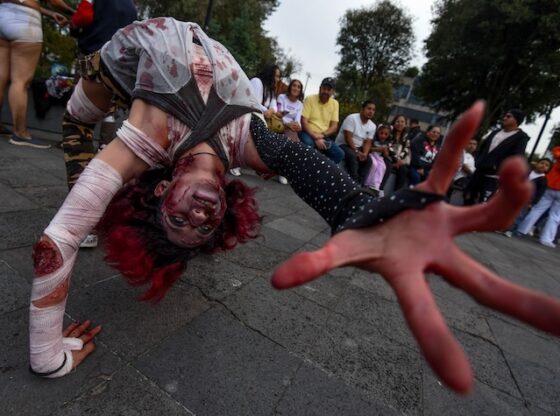

From horror movies to everyday experiences, fear activates our body and mind. Discover why we all feel fear and how to handle it.
MADRID, Nov. 1 (EUROPA PRESS).- While many have fun watching horror movies or entering haunted houses, others avoid any situation that makes their pulse race. As explained by psychologist clinician Manuel Oliva Real, from the Official College of Psychologists of Madrid, the fear It is an essential adaptive response for survivalbut his intensity varies depending on the geneticsthe educationand the experiences lived.
“There are more sensitive people who activate their alert system more easily, and that can turn a normal fear into a disproportionate or even phobic reaction,” says the expert.
Specifically, it details that fear is an adaptive response to a real or perceived dangerous situation, and that it prepares the body to face such a situation. The responses given can be fight, flight, or protection, as specified.
“Fear involves a general activation of the organism at a physiological, cognitive and behavioral level. Once the dangerous situation has been resolved, the organism returns to its original state and the alert response disappears. In this sense, fear is necessary,” the clinical psychologist at the Clinical Psychology Center says during an interview with Europa Press Salud Infosalus.
Why are there more fearful people?
In this context, we asked this expert why there are people who are more afraid than others, and he points out that, really, all people are afraid at some point, since, as we have said, it is an adaptive response that prepares us to face dangerous situations. “It would be negative not to have it. Alertness is necessary when the situation requires it. The reactions of this state of alert vary from one person to another at a physiological, cognitive, and behavioral level,” he warns.
He thus points out that there are people who are more sensitive, probably due to genetic predisposition factors, the education received, as well as the personal history of dangerous experiences. “In any case, fear remains adaptive if it appears in situations of real danger,” he says.
Furthermore, he points out that genetic factors can generate in certain people a predisposition to generate the fear response more easily and more intensely: “This fact, together with experiences and education, can favor the appearance of irrational fears that could constitute phobic reactions.”
What’s more, this clinical psychologist maintains that as children we experience fear reactions in potentially dangerous situations: “There are evolutionary fears, which are normal and in some way necessary. In children it is normal for fear of the dark, fear of strangers, fear of abandonment, or fear of the unknown, etc. to appear. These fears pass with age without the need to do anything with them. They are evolutionary and adaptive fears.”
However, Manuel Oliva Real does specify that if the educational style is excessively protective, or intensely demanding, it can make it difficult for the child to learn effective strategies for coping with threats. “In that sense, the fear reaction will occur in a more intense, rapid, and lasting way, so it can begin to condition aspects of your life and stop being adaptive. Repeated experiences of danger and/or poorly managed can become ‘conditioned’ and favor, in the future, the appearance of irrational fears, or cause the person to live in a state of greater alert,” he adds.
Thus, this clinical psychologist insists that some people enjoy experiences that generate fear while others flee from them because this depends on the genetic predisposition to generate intense fear responses, the experiences lived, the coping tools, and the educational models: “Those based on overprotection favor avoidance behaviors in situations that are interpreted as dangerous when in reality they are not.”
Normal fear vs pathological fear
So, when does a fear stop being an adaptive response and can it represent a problem? This specialist of Official College of Psychologists of Madrid maintains that normal fear is adaptive, and arises in situations of real or perceived danger, so that the fear reaction disappears when the situation is no longer threatening or when it has been faced correctly.
However, it does warn that when the fear response is very intense, it conditions the person’s life, and the situations that generate it do not involve real danger, the fear turns out to be maladaptive. “In this sense, the person may be anticipating dangerous situations and carrying out escape or avoidance behaviors for fear that something negative will happen. That is when we can start talking about phobic fear,” he adds.
💀 The party reaches its climax in the Zócalo. Between applause and flowers, Mexico City celebrates the life, memory and creativity of those who made this parade possible.
Today, each step of the journey becomes a moment that will remain in everyone’s memory… pic.twitter.com/zAM90Cb2SJ
— Secretary of Culture of Mexico City (@CulturaCiudadMx) November 1, 2025
You can learn to manage fear
With all this, the expert at the Clinical Psychology Center affirms that, indeed, one can learn to manage fear, the important thing being to analyze with the person which aspects are directly involved in their fear responses. “From there, coping strategies can be taught that allow situations to be faced more safely. And in general, it is important to offer resources for managing stress and negative thoughts,” he reveals, indicating that the person is taught resources at a physiological, cognitive, and behavioral level.
On a physiological level, it talks about techniques to reduce the physical alert reaction, such as relaxation, mindfulness, as well as breathing techniques and controlled exposure to scary situations.
In terms of cognition, it specifies that the person is taught to reinterpret the meaning of the situations that generate the fear response: “The objective is also to reduce anticipations of what may happen, and learn to live with uncertainty.”
Meanwhile, at a behavioral level, Oliva indicates that resources are offered to reduce avoidance or escape responses, favoring effective coping, while teaching how to channel fear in an adaptive way.
Finally, Manuel Oliva Real, from the Official College of Psychologists of Madrid, highlights that fear is also transmitted socially, and one only has to see it, as he recognizes, in the ease with which minors access content that may not be appropriate for their age: “Traumatic experiences can occur from seeing what happens to other people, or the consequences that arise from those situations. If, in addition, the person has a more genetic predisposition to fear, and does not have effective coping tools, it can generate a maladaptive fear response.