


Faced with the increase in violence that expels thousands of people from their communities, at least five states in the country have legislated to address forced internal displacement. Chiapas, Guerrero, Sinaloa, Zacatecas and Oaxaca already have specific laws, while other entities, such as Chihuahua, Guerrero, Sinaloa and Oaxaca, have classified arbitrary displacement as a crime. In 2024 alone, more than 26 thousand people were displaced by violence, double the previous year.
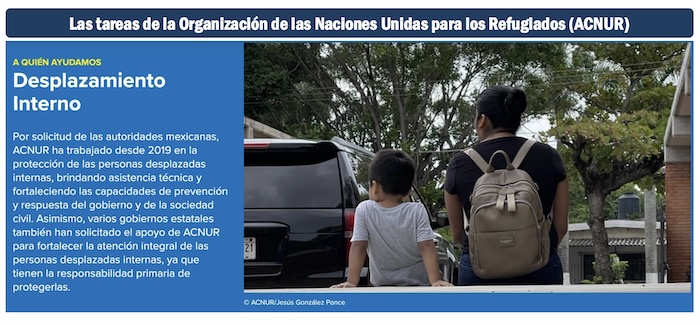
Mexico City, October 30 (However).- The problem of displacedwho flee their communities to escape the violence caused by clashes between gangs of the racketeeringhas led to legislation being passed in at least five entities in the country to care for the affected people, as has happened in the cases of Chiapas, Guerrero, Sinaloa, Zacatecas y Oaxacawarns the United Nations Refugee Agency (UNHCR). In addition, Chihuahua, Guerrero, Sinaloa, Sonora and Oaxaca have classified arbitrary displacement as a crime. Also, there are coordination spaces in Chiapas, Chihuahua, Michoacán and Sinaloa.
Quote the UNHCR on its digital platform that organizations like the Internal Displacement Observatory and the Human Rights Program from the Iberoamerican University, estimate between 26,000 and 28,000 internally displaced people in 2024 due to massive events of violence, which represents an increase of more than 100 percent compared to 2023.
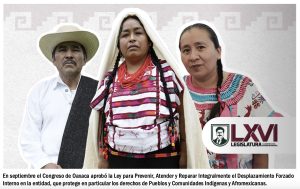
The most recent case of legislation referring to this serious problem is the approval of the Law to Prevent, Attend and Comprehensively Repair Internal Forced Displacement in the State of Oaxaca, issued by the state Congress on September 2, 2025, which states that “internal forced displacement is the fact through which one or more people, individually, family or collectively, are forced or obliged to leave, escape or flee from their place of origin, their lands, territories, or their place of habitual residence in the State of Oaxaca, because their life, physical integrity, security or individual freedoms have been violated, or are directly threatened.”
In what cases are the authorities of Oaxaca obliged to act, when internal displacement of people occurs in the entity?
a).- Due to situations of generalized violence, including that perpetrated by organized crime.
b).- When large-scale projects developed by the State and the private sector are carried out, which are not justified by a public interest, and with respect to which the right to due process has not been guaranteed, particularly in the case of Indigenous and Afro-Mexican Peoples and Communities.
c).- For the transfer or relocation of Indigenous and Afro-Mexican Peoples and Communities outside their territories, which violate the rights of those communities in Oaxaca.
d).- Due to a disaster or adverse effects of climate change.
e).- Due to violence generated by agrarian conflicts related to territorial limits.
f).- Due to violence generated by the illegal and arbitrary invasion of territories.
g).- For violence committed against human rights defenders, including environmental defenders.
h).- For violence committed by political groups or social organizations, as well as violence against freedom of expression and the right to information.
i).- Due to segregation practices motivated by political, ethnic, religious, disability reasons or related to the sexual orientation, gender identity and expression of the affected population.
j).- Due to persecution, segregation and exclusion against women and girls that results in the restriction of their rights, and that leads to their permanence in their communities being intolerable or unsustainable.
What are the direct effects of forced displacement that the Oaxaca authority must address according to the new law on the matter?
1.- Security crisis and risk of people in situations of forced internal displacement to be victims of recruitment by organized crime groups.
2.- Risk of being victims of human trafficking, or some other form of exploitation.
3.- Discrimination; impoverishment, unemployment and loss of livelihoods; deterioration of ways and conditions of life.
4.- Increase in sexual and gender violence against women and people of sexual diversity, as well as the increase in the situation of vulnerability for girls, boys, adolescents, and other priority attention groups.
5.- Affects to physical and psychological integrity; increase in diseases and mortality; food insecurity; overcrowded housing conditions and systematic violation of their human rights.
CHIAPAS
There are some states in the country in which the problem of displaced people has worsened in recent years.
The violence of organized crime causes a crisis of forced displacement in Los Altos de Chiapas, warns on its digital platform the Fray Bartolomé de las Casas Human Rights Center, an institution that has documented that from 2010 to 2021, approximately 14,476 thousand displaced people had been registered in the state of Chiapas. In the Los Altos region of Chiapas, the phenomenon has worsened due to the actions of illegal armed groups, specifically in the municipalities of Chalchihuitán, Chenalhó and Aldama; some of these linked to organized crime as in the case of the municipalities of San Andrés Duraznal and Pantelhó, all of the Mayan-Tsotsil people. In Aldama, Chiapas alone, the forced displacement of more than 3,000 people has been documented.
On its digital platform, this human rights defense center explains that due to the characteristics that displacement is currently taking place, we consider it a form of torture since the population is under constant siege, they instill fear, terror, physical and mental suffering, in order to control the territory and appropriate it. The population as a whole experiences daily violence. She finds herself involved in a context that becomes torturous. It is important to mention that the victims of indigenous peoples suffer transversal injustices: due to their culture, language and sex. In addition to food shortages.
The situation in Chiapas is serious and requires comprehensive attention, since forced displacement, due to the causes that generate it, its consequences and conditions in which the displaced people find themselves, as well as its physical, psychological, community effects and the irreversible damage caused by this traumatic event at the personal and community level are comparable to torture and other cruel, inhuman or degrading treatment or punishment, says the Fray Bartolomé de las Casas Human Rights Center.

HOT LAND
Since the beginning of 2025, nearly 500 families have been displaced from the rural area of the municipality of Apatzingán, and although it is true that more than 300 have returned to their homes, there are still about 150 families outside their homes in towns with less than 200 inhabitants such as Las Huertas, El Alcalde, El Guayabo, Holland, El Morado, Bateas, Loma de Los Hoyos and Presa del Rosario, who fear narcomines and clashes between organized crime groups, declared Sandra Garibay, local representative for that region of Tierra Caliente, published on March 31, 2025 in the newspaper La Jornada of Mexico City, in an information signed by the correspondent in that region, Ernesto Martínez Elorriaga.
In July 2022, the Mexican Journal of Political and Social Sciences of the National Autonomous University of Mexico published a study called Forced Displacement of Women from Aguililla, Michoacán, to Tijuana, Baja California, due to Criminal Violence, carried out by researchers Karen Muro Aréchiga and Oscar Rodríguez Chávez, which describes the unique migration from the municipality of Aguilla, Michoacán, to the northern border.
According to the study, the Population and Housing Census of the National Institute of Statistics and Geography (INEGI) 2020 shows that from 2015 to 2020, 877 people migrated from Aguililla to other entities and municipalities in Mexico. The main destinations were municipalities located in other regions of Michoacán such as Uruapan, Morelia, Apatzingán and Coalcomán (…), but migrations are also observed to other entities and more distant municipalities such as Tijuana, Ensenada and Playas de Rosarito in Baja California, the city of Colima and Zihuatanejo, Guerrero. People left their municipality fleeing the violence derived from the confrontation between groups associated with the Jalisco New Generation Cartel (CJNG) and local organizations of the United Cartels (CU).
Researchers Karen Muro Aréchiga and Oscar Rodríguez Chávez add that the internal migration data from Aguililla, Michoacán, should be taken as the minimum level, since all those cases are left out where the respondents did not want to provide information about the specific municipality of residence five years ago, for various reasons including security, and that in the case of Michoacán they represented almost 24,500 people, who in 2020 resided in some entity on the northern border of Mexico and mainly in the municipalities of Tijuana, Mexicali, Ensenada, Playas de Rosarito and Tecate in Baja California and in Ciudad Juárez, Chihuahua.

JALISCO
In Jalisco, the phenomenon of displaced people has also been experienced due to the violence generated by the first organized movement. Information published by Radio Universidad de Guadalajara and signed by reporter Isaack de Loza on January 24, 2024 indicates that after 150 families from the towns of Zipoco, El Carrizo, Panales and Petacala, all located in the municipality of Santa María del Oro, were displaced by members of organized crime, the Government of Jalisco announced that measures have been taken to restore order in the area. The state government assured that federal and state forces would reinforce their presence in the area by recognizing that the displacements were a consequence of the violence generated by a confrontation between rival criminal groups from Michoacán and Jalisco.

The same informative note adds that in May 2021, an exactly similar situation occurred in the municipality of Teocaltiche, located in the Los Altos Region of Jalisco, where groups belonging to the Jalisco Nueva Generación and Sinaloa cartels clashed. More than 600 residents of communities such as El Saucito, El Rosario, Los Garcías, Rancho Santo, Rancho Mayor and Aguantina, in Teoicaltiche, were forced to leave their communities and move to other regions of Jalisco or the neighboring state of Aguascalientes, to avoid being victims of violence.
The situation of people forcibly displaced due to violence is an issue that requires both the federal government and the country’s 32 states to update their timely and sufficient humanitarian aid protocols.