


Published On 9/12/2025
|
Last update: 07:59 (Mecca time)
The racist occupation policies in Jerusalem burden the Palestinians, who are haunted by the lack of all basic services. Therefore, Palestinian institutions are considered the first line of defense for a life threatened by constant marginalization.
In light of the deep gaps in the education and culture sectors, the institutions operating in these two sectors find themselves facing a double responsibility to serve the local community. They must provide what the official authorities do not provide to the Jerusalemites, to be an essential lever for their advancement under the constant pressure they are under.
Read also
list of 2 itemsend of list
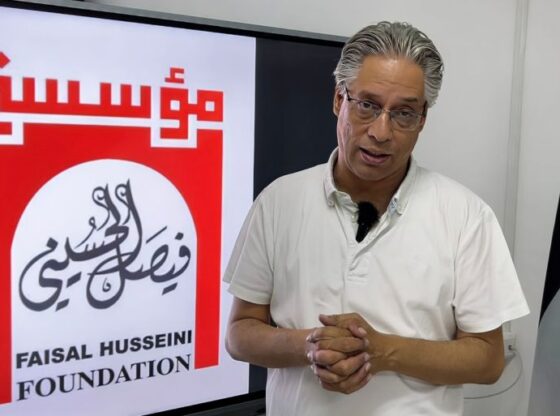
The Faisal Al-Husseini Foundation, which was established in 2002, is considered one of the most prominent institutions working to advance Palestinian schools in the occupied city. It focuses its work on developing teaching and learning based on research and higher thinking skills and on providing a safe, stimulating school environment that meets the emotional, educational and social needs of school students.
The Foundation works with schools affiliated with the Palestinian umbrella, on training programs, infrastructure development, and emergency support programs, within a vision of developing education based on critical thinking, higher thinking skills, and scientific research within an environment that enhances Palestinian identity, ensures that generations know their Palestinian narrative, and preserves children’s rights, democracy, and equality.
Huge gaps
In a question posed by Al Jazeera Net to the Chairman of the Board of Directors of the Faisal Al-Husseini Foundation, Abdul Qader Al-Husseini, about the most prominent gaps in the education sector in Jerusalem, and how the Foundation is trying to fill the gaps in this field, he answered that the gaps are huge, especially at the level of infrastructure, where there is a significant shortage of school seats, as statistics show that more than 9,000 school-age children are studying outside the city limits, and this gap is constantly increasing, because it was estimated less than a decade ago at 6,000 students.
Al-Husseini added that there is a need to build 80 new classrooms every year to keep pace with the population increase, and that civil society organizations and international institutions provide part of these needs as a result of the failure of the occupying party to carry out its duty in this area on the one hand, and its waging war on schools and its tendency to close schools run by civil society organizations and close UNRWA schools on the other hand.
Al-Husseini added, “These conditions and occupation policies are also reflected in the quality of education in Jerusalem, and this appears in the results of international examinations, which are due to several reasons, including placing obstacles to attracting specialized teachers, persecuting schools that teach the Palestinian curriculum, and insisting on imposing a curriculum that portrays the Palestinian as inferior and undeserving of having his own entity or infrastructure, and preparing him to integrate into a system that is hostile to him and at the lowest level of its economic and social ladder.”
Many challenges
Regarding the most prominent challenges facing the work of institutions operating in the education sector in Jerusalem, Al-Husseini stressed that they face challenges on several levels, including building a network of solidarity between schools, and launching awareness-raising campaigns regarding plans targeting the Palestinian educational system in the city.
It also faces challenges in providing training programs that keep pace with technological developments and market needs, and those that focus on higher-order thinking skills and modern devices and tools, in addition to providing infrastructure programs that provide an appropriate environment and better quality of education and to prepare generations for a future in which they control their destiny, and are not merely followers and servants of systems that discriminate against them and do not recognize their being.
Abdul Qader Al-Husseini did not neglect to address the scarcity of funding when compared to the needs or budgets spent on education in the world, and the slowness of infrastructure work as a result of preventing workers coming from the West Bank from reaching Jerusalem, and thus institutions face high costs as a result of inflation and the scarcity of manpower.
The Chairman of the Foundation’s Board of Directors concluded his speech by answering the question: Does the work of the institutions become more difficult over time in light of the further restrictions on Palestinian schools that pass the Palestinian curriculum? He answered that despite the narrowness of the work space over time, the ability of institutions to adapt and innovate solutions to confront various challenges increases, and “we are optimistic about the future and the ability of Jerusalemite society to withstand and thwart attempts to isolate and fragment it.”

Master the art of dribbling
In the culture sector, Al Jazeera Net asked the director of the Palestinian National Theater (Al-Hakawati), Amer Khalil, about the role of cultural and artistic institutions in preserving the Palestinian narrative in Jerusalem. He said that they play an important and vital role in preserving it through artistic works in all their forms, whether through performing arts such as theater and music that rely primarily on story telling, or other arts.
The two theatrical works, “Al-Manshiya” and “Jerusalem Mosaic,” are among the works that the theater recently produced and fall within the framework of protecting and promoting the novel.
Regarding how Jerusalemite cultural institutions deal with the difficult reality in light of marginalization on the one hand and attempts at Israelization that include all sectors of life on the other hand, Khalil explained that cultural institutions have practiced the art of evasion and passing things smoothly without affecting the course of their work. “Every institution, according to the nature of its work, has created its own mechanism for survival and steadfastness, because the Israeli attack on Palestinian culture is not the result of the moment.”