

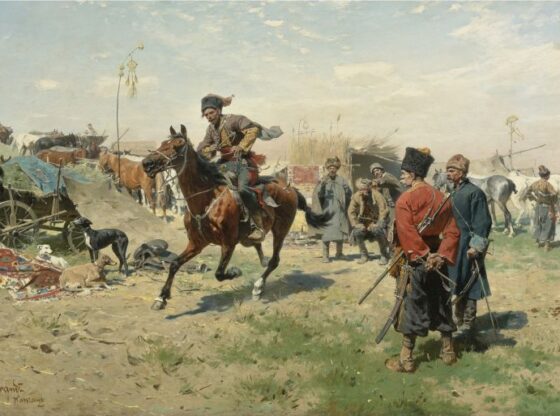

Cossacks are a military ethnic group that arose in the 15th and 16th centuries AD on the southern and southeastern edges of Russia, and they played a major role in expanding and defending its borders.
Over time, their number increased steadily due to the increasing number of refugees to these lands to escape certain laws or taxes.
It is an ethnic or ethnographic subgroup within the Russian people, having much in common with other Russians.
The Cossacks formed a class with military traditions, a special culture, and a unique way of life, as they guarded the borders, performed military service, and belonged to different peoples (Russians, Ukrainians, Tatars, and Ossetians).
They participated in numerous wars and explored new territories (Siberia, the Far East, the Caucasus), and in return for their loyalty to the state they were granted lands and privileges, and became a distinguished military class in the Russian Empire.
Origin of the name
The word “Cossack” first appeared in a written source in the Russian language in 1395 AD, and means “free man” or “independent worker.”
Some historians believe that the origin of the word goes back to the Turkish language, and that it has multiple interpretations, such as “free man,” “tramp,” and even “thief.”
Other accounts say that the word has a Mongolian origin, and that it is made up of two syllables: “ku” (which means shield) and “zakh” (which means borders), and then the proponents of this interpretation believe that the word “Cossack” literally means “border guard.”
Their role in the Russian Empire
The Cossacks lived on the dangerous borders of the country, and had their own traditions, clothing, songs and way of life, different from those of the peasants, with great emphasis on military valor and loyalty to Orthodoxy and the Tsar.
Until the fourteenth century, they practiced plunder and robbery, but the situation changed in 1549 AD, when Ivan the Terrible began recruiting them into government service, and they became part of the irregular forces. Since the seventeenth century, they have become a distinct military class, and their main mission was military service, hunting, and guarding the borders.
Historical documents described them as “protectors of the Russian land,” and they participated in almost all of Russia’s battles and wars since the era of Ivan the Terrible.
They also contributed significantly to the discovery and development of new lands beyond the Ural Mountains and in Siberia and the Far East (Kolima, Kamchatka, Transbaikalia, and the Amur region).
Border protection
From the 15th century to the 17th century and beyond, the Cossacks served as a “human shield” on Russia’s turbulent southern and eastern borders, protecting the country from raids by the steppe hordes and other external threats, and also contributed to collecting its taxes and running its “customs.”
The Cossacks officially participated for the first time (within the Tsarist army) in the invasion of Kazan in 1552. They not only stormed the city, but also carried out digging operations under the city’s citadel, placing barrels of gunpowder in them, and setting them on fire. The walls were partially destroyed, and the Cossack army entered the city.
Cossack troops took part in almost all of Russia’s major wars: against Napoleon, in the Caucasus, in the Crimea, in the Russo-Turkish Wars, World War I and World War II.
In addition to military service, Cossacks engaged in land development and reform, postal services, quarantine and environmental protection, and contributed to developing infrastructure in remote areas.

Soviet era
After the Bolshevik Revolution in Russia in 1917, the Cossacks were subjected to repression and the authorities confiscated their property and carried out mass deportations against them. During that period, a division occurred within them, as part of them supported the revolution while the other part fought it.
Cossacks were banned from serving in the Red Army until 1939, when restrictions were lifted in appreciation of their loyalty and willingness to defend.
In World War II, Cossack units were revived in the Red Army, but they also faced the dilemma of division, when some of them found themselves in hostile formations fighting against the Soviet Union alongside Germany, in formations created by the Germans, but many of them nevertheless defected and joined the Red Army.
Cossacks after the collapse of the Soviet Union
After the collapse of the Soviet Union in 1991, the group witnessed a revival, and became a socio-cultural phenomenon and a social and political movement in Russia.
For Cossacks living in the border regions, the collapse of the Soviet Union led to divisions along the state’s borders. For example, the Cossacks of Semirchia found themselves divided between Kazakhstan and Kyrgyzstan.
Moreover, the 1990s witnessed a mass exodus of Slavs, including Cossacks, from some former Soviet republics (such as Kazakhstan) to Russia.
In that period, the idea of reviving the Cossacks emerged from the shadows with the beginning of perestroika, and Cossack associations and federations began to actively form, such as the Russian Cossack Union and the Siberian Cossack Army.
In 1992, the Russian Parliament adopted a decision to “rehabilitate the Cossacks”, with the aim of restoring historical justice after the repression and policies of “de-Cossacking” in the Soviet era.
Role revival
Cossack associations in contemporary Russia are involved in maintaining public order, protecting forests, responding to emergencies, guarding state borders, and are also involved in the military education of youth and the preservation of traditions.
The Cossacks transformed from a community suppressed in the Soviet era into an officially recognized element of Russian society with specific government functions and active participation in cultural and public life.