

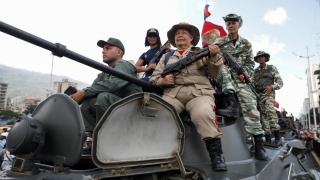

In the first week of October, Venezuela declared a “state of external shock”, the last measure taken by the regime. Nicolas Maduro facing the presence of the United States armed forces and the beginning of Christmas.
Accompanied by the detonation of fireworks launched from the Helicoide, one of the largest torture centers on the continent, Chavismo repeats the advance of the holiday season to reinforce what it defines as the country’s economic growth, a “vaccine against the bitter, the fascists and the violent,” in the words of the president.
Judging by the latest demonstrations called by Chavismo, these insults apply to an increasingly larger component of the Venezuelan population.
Numerous marches and demonstrations by the ruling party show a considerable decline, even with the mandatory attendance of public officials, and images and videos assisted by artificial intelligence are already common on social media accounts that attempt to show greater public support than exists for the ruling party.
And given the possibility of a regime change, several Venezuelans from different parts of the country who declare on condition of anonymity affirm that it would be an ideal situation, whether or not there is an intervention by the administration of the American president, Donald Trump.
“We have been enduring humiliation, contempt and many needs that we cannot solve for 26 years”says a woman who works in agriculture in the Andean region of the country, who claims that in the region it is impossible to achieve “a decent life.”
“Only a few get rich, a elite who are those in power and the connected,” he adds, referring to those who profit through their dealings with the Government.
There are no more up-to-date or more representative figures than those from last year’s presidential elections, confirmed only in the electoral records collected by the opposition leader’s team. Maria Corina Machado.
Edmundo González Urrutiacandidate of the Democratic Unitary Platform, won more than twice as many votes as the United Socialist Party of Venezuela (PSUV), led by Maduro, who took advantage of his control over the National Electoral Council and the Supreme Court of Justice so that the former delegated to the latter the responsibility of declaring his victory without presenting evidence. The largest electoral fraud in the history of the country.
On the other hand, Chavismo still has the support of certain components that have become radicalized to the point of “trusting only what the Government officially says,” as detailed by a university professor who is a supporter of the regime.
“Don’t believe anything from anyone,” he says. “If you knew, you could speak, but you do not know nor have the authority to do that, so do not multiply either [republiques] nothing that is not from the official bodies of the national Executive and the governorates and states”.
However, this professor ventures an opinion that is outside the official position of the Chavista Government. “Those ships [estadounidenses] They are not going to attack, it is a way to intimidate our country, our president, to create a psychological shock,” he says, emphasizing that the attacks against fishing boats that have left at least 17 dead on the coasts They were “a smoke bomb” that “now they have to pay”.
It is a much more daring initiative than the one shown by Chavismo spokesmen to their counterparts abroad.
But it is also an analogy of the incoherence of the messages of the ruling party, which seeks Trump’s complacency while distributing weapons of war to militiamen and paramilitaries and declaring a state of exception that expands its powers, overcomes the usual transparency controls, forces control of public resources and legalizes the limitation of constitutional freedoms.
This decree, the content of which has not been officially published so far, implies the restriction of fundamental rights, according to the NGO Acceso a la Justicia, which demanded its publication “immediately.”
It should be noted that these rights have been systematically violated for years with the detention and torture of political opponents and communication and human rights defense professionals, as well as children and adolescents. Until now there are 838 political prisoners in Venezuela, according to data from the NGO Foro Penal.
A direct intervention?
The complaint by the Venezuelan Minister of Defense, Vladimir Padrino Lópezpointed to the detection by Venezuela’s integrated air system of five North American fighter planes that approached the Venezuelan coast, which he described as a “provocation” and a “threat to national security.”
Chavismo tries to dissuade the United States with letters and peace speeches while organizing maneuvers and military deployments, but Venezuelans debate the possible results.
The Andean farmer defines a hypothetical direct action by international forces as something “fair.” “Many of us are out in the open because there is no future, everything is chaos because a Government cannot remain for so long,” he laments, highlighting that, although it is not the only option, any change must be aimed at “raising the standard of living and also being able to help others.”
From the state of Zulia, a woman involved in local politics says she prefers that the Americans “not enter by force so that there are no deaths.” The best scenario that comes to mind is that the members of the regime “flee so that we can dawn without them and that the bloodshed ends,” with the possibility of opening the country to foreign investments.
It points to a fact that few detractors of US “provocations” mention: the situation of political violence and economic volatility is already unbearable for the majority of Venezuelans, and international negotiations have only served to prolong the regime’s mandate.
“Notice that all international organizations are against the dictatorship, but nothing happens because they cannot act in a sovereign country,” he alleges. “I pray to God that there do not have to be deaths for them to leave, but remember that if they leave Venezuela, they fall into prison.”
A retail businessman from Caracas expresses himself more pragmatically. “As long as the countries in the region do not help with the transition, more and more Venezuelans will continue to arrive at their borders, whatever immigration policies they adopt,” he says, adding that he would “expect at least some stability” in their quality of life if there is a change in government, regardless of what causes it.
“Every day we live in uncertainty about what may happen; I wish I could avoid the continuous precariousness in which we live,” he concludes.
The economy as a trigger
Even ignoring all the human rights violations described in the latest report of the Fact-Finding Commission for Venezuela, dependent on the United Nations, the economic crisis is one of the factors that are repeated in the explanations of the desire of several Venezuelans to “exit the regime.”
A Venezuelan economist, speaking anonymously, points out the “exchange gap” between official and black market currency exchange rates as one of the factors that most aggravates the purchasing power of citizens and makes it difficult to maintain companies of all sizes after a few years of “exchange stability.”
There has been a drastic drop in the entry and circulation of dollars since the controversy over the American oil company Chevron. The company temporarily suspended its operations in Venezuela and is now restricted in its ability to deliver direct payments to the Latin American regime and the state oil company.
What remains, in the words of the economist interviewed, is “a reduced and battered economy” where “producers have been forced to turn to the unofficial market, raising the cost by 25% or even 50%, while forcing them to sell at the official dollar rate, which causes great losses.”
On the other hand, it highlights the impact of sanctions against specific agents within the Government or associated with it who “They created businesses and reactivated certain sectors by being forced to leave their money in the country and launder it to be able to get it out”.
The Andean farmer interviewed blames her harvest losses on this situation of uncertainty. “There are many of us affected who live off the land, and if things went well for us, many people would also benefit, but with the political situation we cannot save or carry out projects or help so many people who are in hospitals and cannot afford medications or exams,” he laments.
For his part, the Caracas merchant points out that “It is crazy to want to produce when the State devalues the bolivar (the national currency) every day”.
“Working in an SME is demoralizing when you see how state entities force us to sell at a loss with an exchange rate well below the market while suppliers sponsored by the State refuse to sell to us in bolivars or receive bolivars at the parallel rate.”
Division between opponents
The electoral disenchantment encompasses all those interviewed who voted for González Urrutia, given the discrediting of the independence of the CNE; The majority continues to support Machado’s initiatives, who from underground calls for mobilization in the near future appealing to the hope of radical change.
However, a political sector has spoken out against Machado’s strategy, which has sought international allies, especially Marco RubioRepublican US senator, without explicitly defining their role beyond their public support in what he calls the “transition.”
The figure par excellence of this division is Henrique Capriles Radonskywhich has spoken out against the alleged US invasion and has described Machado’s team as “extremists” for confronting the regime instead of seeking a negotiation in which the US leaders participate.
These concessions to Chavismo have reached the point that several political figures have minimized or questioned the evidence of the Government’s role in drug trafficking and organized crime, even after accusing them of the same thing years before, as was the case of Capriles.
These accusations justify the presence of the US Navy in the Caribbean, according to Trump’s spokespersons, who deny seeking a change of government in Venezuela. For his part, Trump assured this Tuesday that he will expand these operations to confront “the cartels that arrive by land.”
This conciliatory attitude has not permeated the majority of the population. The Venezuelan political scientist Ana Milagros Parra highlights that Machado remains the “legitimate leader so far, with the highest approval rates and an electoral victory that could not be cashed in,” while the proponents of these direct negotiations with Maduro’s team “are co-opted” and “they seek individual positions and instrumentalize any citizen demand”.
“They secretly negotiate with the Government, disrespecting the unity of the opposition, as when several were expelled from the Unitary Platform for participating in the regional elections, going beyond the line of abstention called,” he affirms, emphasizing that “they are initiatives that are not in favor of freedom, it is an opposition to the measure put in place by the Government, while María Corina’s group does denounce oppression and violations of human rights and calls it a dictatorship”.