


Published On 4/11/2025
|
Last update: 12:45 (Mecca time)
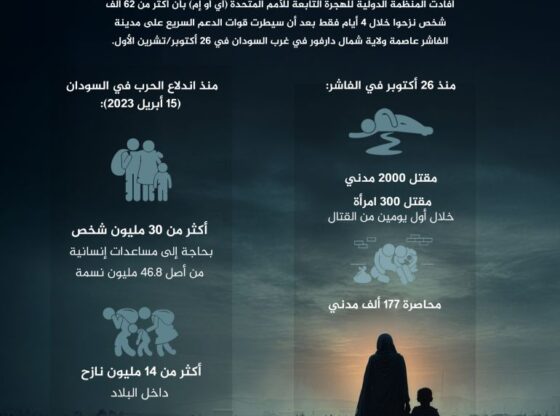
The city of El Fasher, the capital of North Darfur, is experiencing one of the bloodiest days since the outbreak of war in Sudan. The Rapid Support Forces’ control of it on October 26 led to the killing of thousands of civilians within a few days, and the displacement of more than 62,000 people in less than 4 days, while about 177,000 remained trapped under siege without safe passages or aid.
As the violence expands, the name of the Rapid Support Commander, Mohamed Hamdan Dagalo, known as Hemedti, emerges as the most controversial figure in the country, as he is accused of leading a broad military campaign during which his forces carried out systematic massacres in Darfur and Kordofan, which was described as ethnic cleansing against tribes such as the Masalit.
Hemedti was born in 1974 in the Darfur desert. He left school at an early age to join the Janjaweed militias, whose role became prominent during the Darfur war at the turn of the millennium, when former President Omar al-Bashir used them to suppress the armed rebellion.

In 2013, these militias turned into an official entity under the name “Rapid Support Forces”, affiliated with the Security and Intelligence Service, and remained under the leadership of Hemedti, whose influence expanded by controlling gold mines in Darfur and Kordofan, making him one of the richest and most influential men in Sudan. After the fall of the Bashir regime in 2019, Hemedti became Vice-President of the Transitional Sovereignty Council, but he remained in a state of tension with the army, especially after the plan to integrate the Rapid Support Forces into the military institution was proposed.

On April 15, 2023, the confrontation between the two sides exploded into an open war that extended to the states of Darfur, Kordofan, and Khartoum, during which thousands were killed, while the Rapid Support Forces were accused of committing mass massacres and widespread human rights violations, targeting civilians in several cities, especially in the Darfur region. Local and international organizations documented dozens of incidents that included extrajudicial killings, rape, looting, and ethnic cleansing in some areas.

The map of field control in western Sudan has changed today, and most of the states of Darfur and parts of the states of the Kordofan region are under the control of the Rapid Support Forces, while the army is expanding in the rest of the northern, eastern and central states and cities.


As the fighting continues, waves of displacement are increasing, as data from international organizations indicate that more than 14 million people have fled their homes inside Sudan or crossed the border, while more than 30 million need urgent humanitarian aid.


The fall of El Fasher was not just a military transformation, but rather a moment that redrew the map of the conflict politically and humanitarianly, and placed the international community before a very complex equation: a leader that some see as a man of the moment, and that the United Nations sees as a potential accused of committing war crimes, and a people fleeing from under fire towards the desert and borders without a homeland or a clear horizon.
In light of this scene, Darfur and Kordofan appear to be on the cusp of a new reality, whose borders are drawn by fire and displacement, amid a question that grows more weighty every day: Will Hemedti rise to the pinnacle of power, or will he fall under the weight of the blood being shed in El Fasher and other forgotten cities of Sudan?